
Great British Savings Report 2026
Explore UK savings habits and trends, and discover how digital banking, financial pressure, and changing technology are reshaping the way Britain saves.

The app gave us access. Did it make us better savers?
Fifteen years into the era of banking apps, managing money has become quicker and more convenient. We can check a balance, move money or open an account in seconds.
But easier access does not necessarily lead to more active savings decisions.
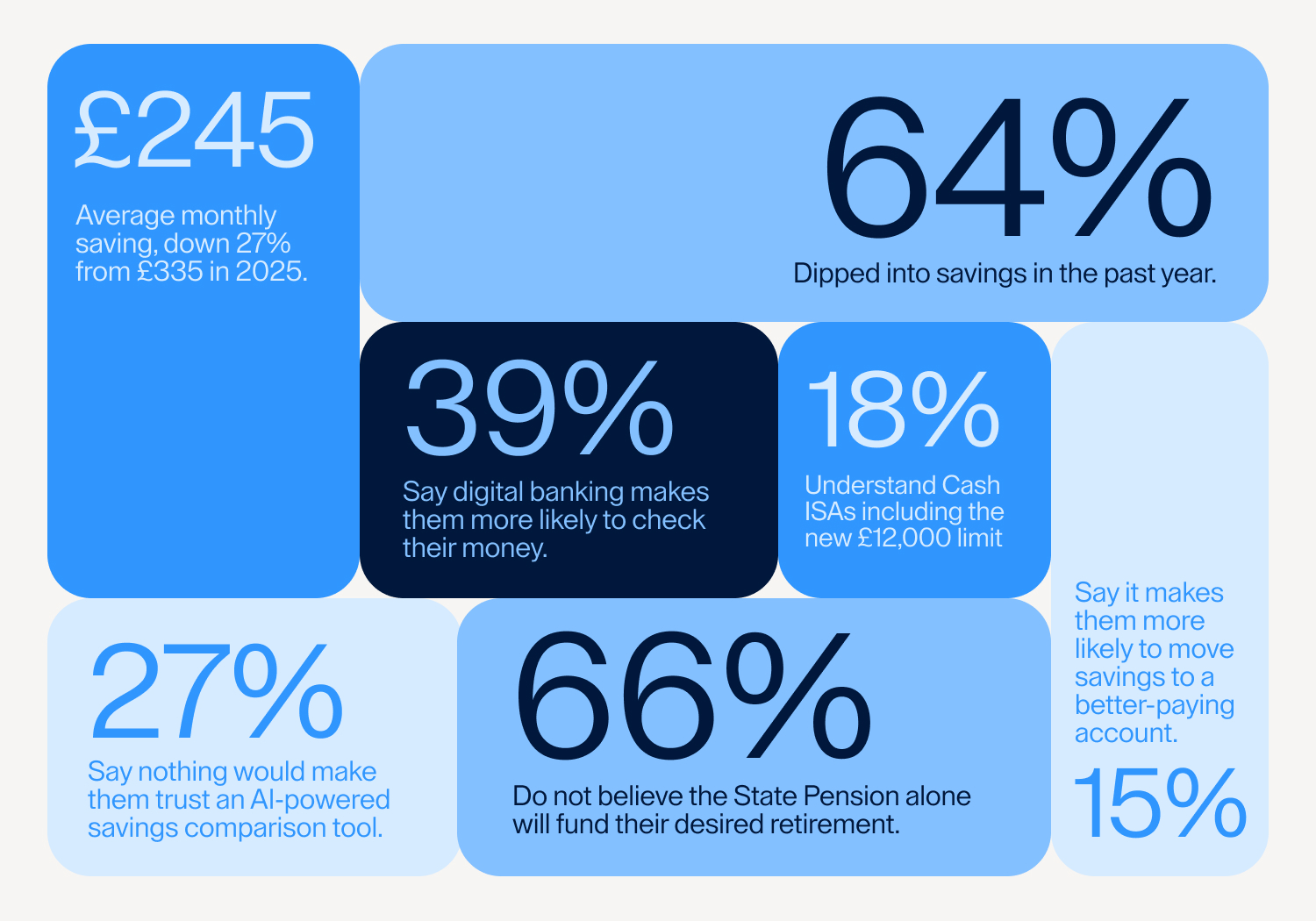
Raisin UK’s Great British Savings Report 2026 explores how digital convenience fits into the way Britain saves today. The findings show people are regularly checking their money, but saving less each month, dipping into their pots more often and placing greater importance on being able to access their cash.
At the same time, savers are facing new decisions around Cash ISA reform, retirement planning and emerging technology.
Fifteen years on, the next challenge is no longer simply making money easier to access. It is making the available choices easier to understand.
Key Findings
Have banking apps made Britain better at saving?
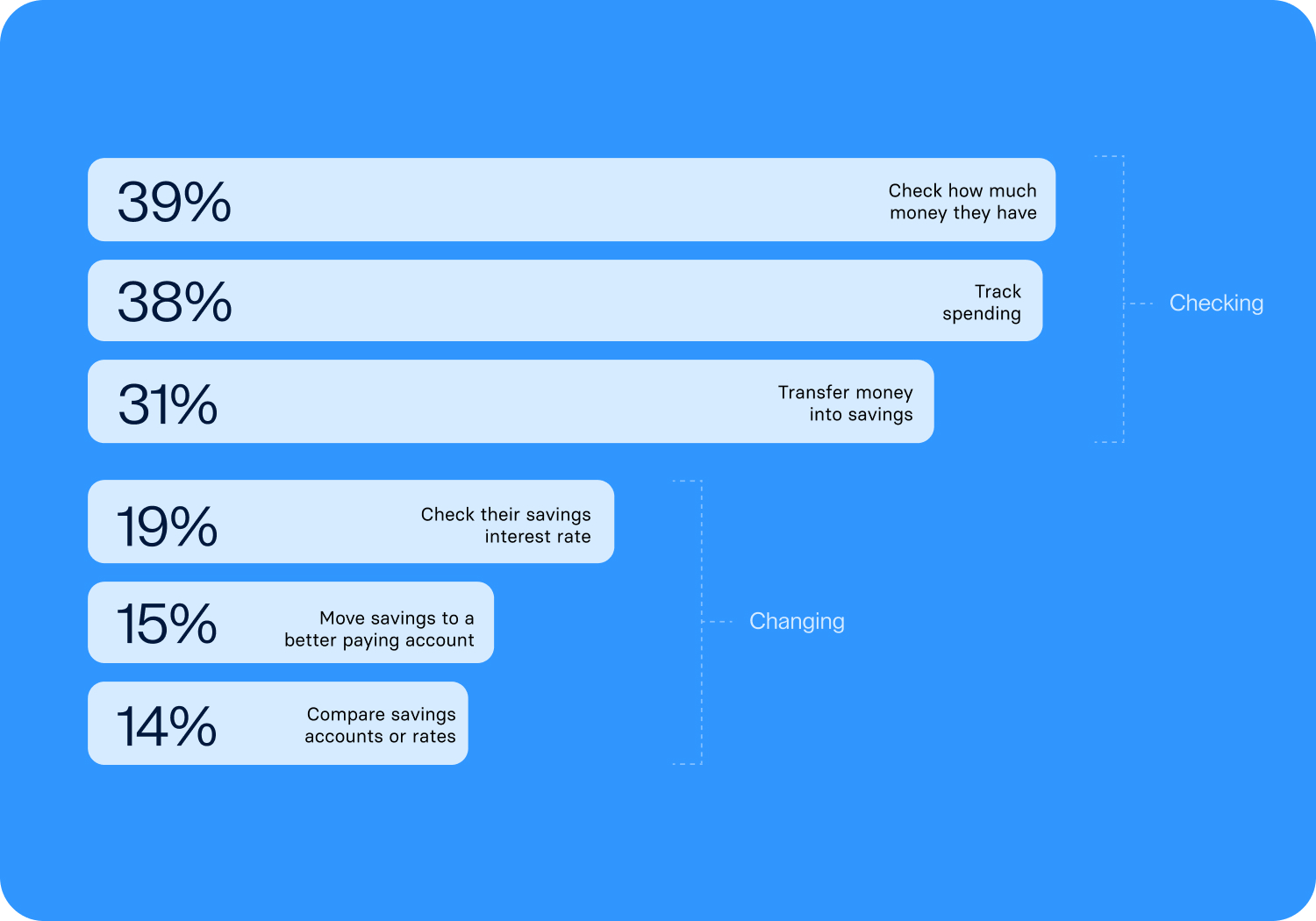
Digital banking appears particularly effective at helping people manage money day to day. Nearly two in five people (39%) say it makes them more likely to check how much money they have, 38% say it helps them track spending and 31% say it makes them more likely to transfer money into savings.
But the numbers fall when it comes to optimising those savings. Just 19% say digital banking makes them more likely to check their savings interest rate, 15% say it encourages them to move money to a better-paying account and 14% say it makes them more likely to compare savings accounts or rates.
The gap also shows up in wider savings behaviour: one in five people with savings (20%) leave their money where it is because it sits alongside their current account, while only 10% regularly compare and move savings through websites or apps.
The full report explores what sits behind this gap between checking and acting, and what people can do to make more informed decisions about their savings.
Everyday money management vs savings optimisation
Average monthly savings in the UK are falling
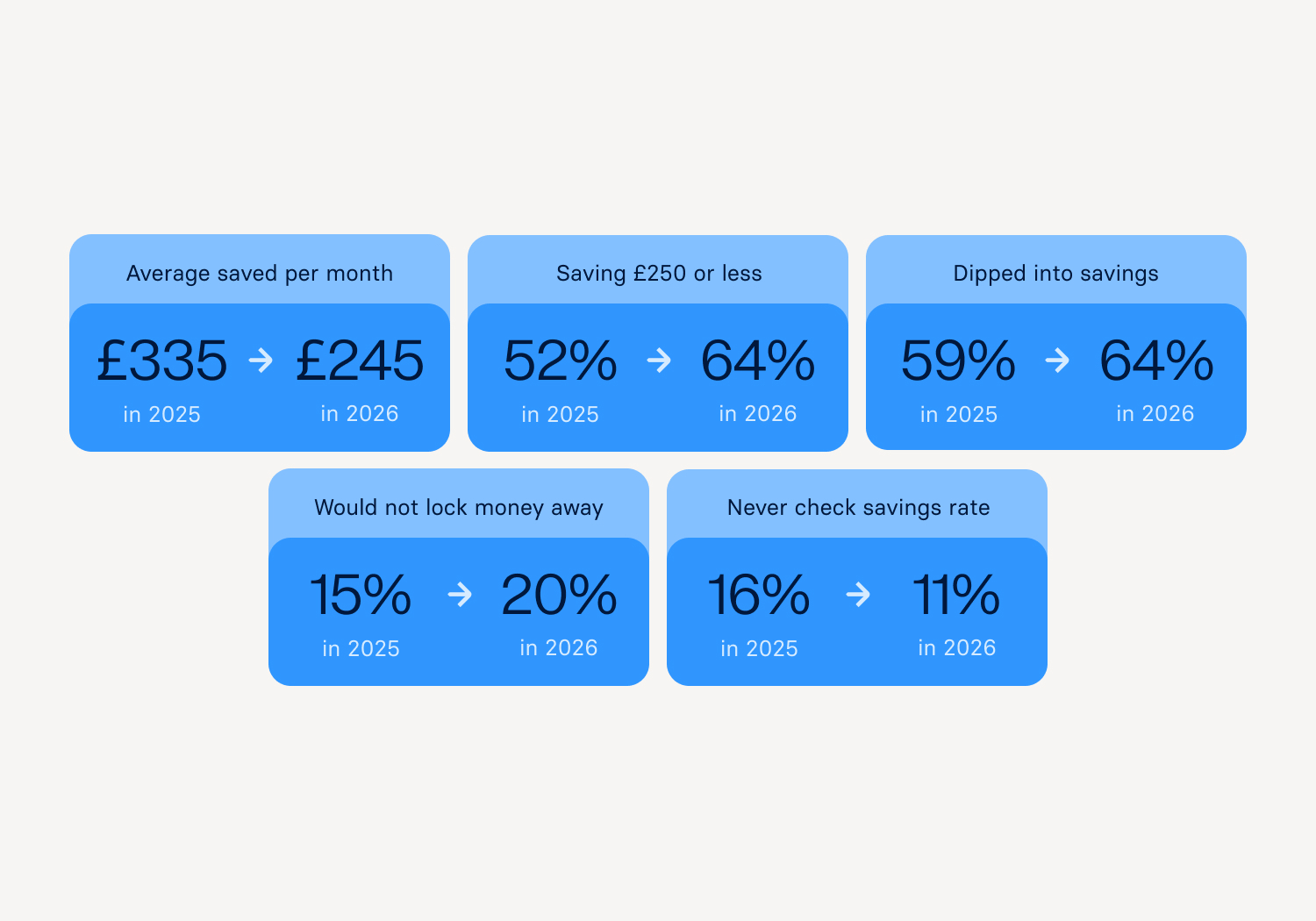
Among people currently saving for something, average monthly savings fell from £335 in 2025 to £245 in 2026 - a decrease of £90, or 27%.
Nearly two-thirds (64%) now report saving £250 or less each month, compared with 52% last year. At the same time, one in five (20%) say they would not lock money away because they need unlimited access, up from 15% in 2025.
Existing savings are also being used more often. Nearly two-thirds (64%) of people with savings accounts dipped into them in the past year, up from 59%.
The leading reason for dipping into savings is everyday living expenses such as groceries and bills (42%), followed by unexpected household repairs and travel or holiday costs at 25% each.
With savings increasingly used as a financial buffer, the full report looks at how long people’s savings could cover essential spending, how much emergency cash households may need and why access is becoming increasingly important.
The Great British Savings Barometer
The savings landscape is changing
From Cash ISA reform to retirement planning and emerging AI tools, savers face a growing range of choices about how they manage their money.
From 6 April 2027, the annual Cash ISA allowance will drop to £12,000 for people under 65, while the overall ISA allowance remains £20,000. People aged 65 and over will retain a £20,000 Cash ISA limit.
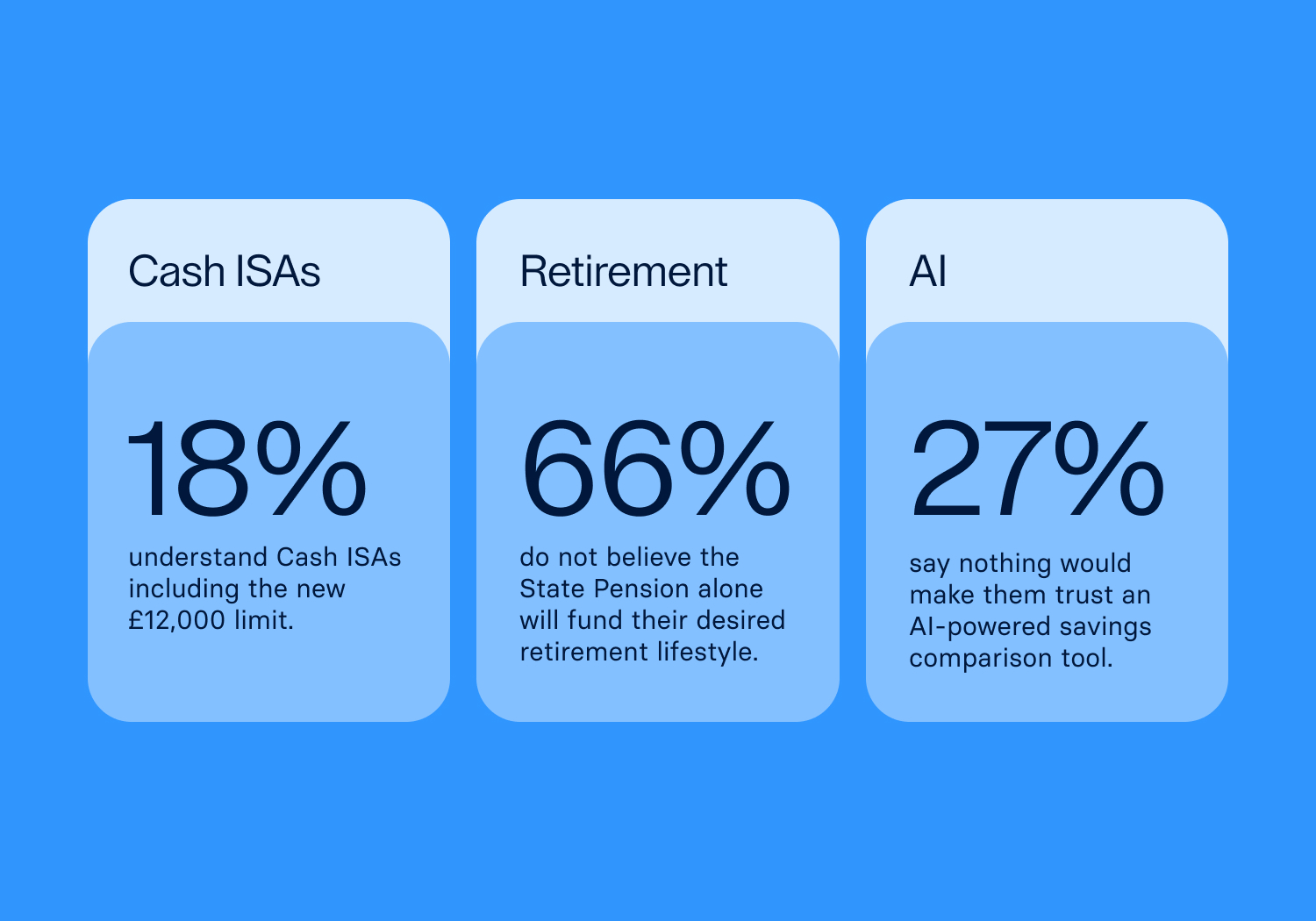
Yet only 18% of respondents say they understand Cash ISAs, including the new limit. At the same time, 44% of current Cash ISA users say they are likely to introduce or increase their use of a Stocks and Shares ISA after the change.
Retirement raises another challenge. Two-thirds (66%) do not believe the State Pension alone will fund the retirement lifestyle they want, suggesting many expect to rely on a mix of pensions, savings, investments and other income in later life.
Technology is changing the picture too. More than a quarter (27%) say nothing would make them trust an AI-powered savings comparison tool, while the strongest factors that could build trust include being able to verify the results themselves, and having human oversight.
The full report explores how these attitudes vary by age, gender and location, including which generations are most open to AI, where savings are under the greatest pressure and how retirement expectations are changing.
Three decisions shaping saving
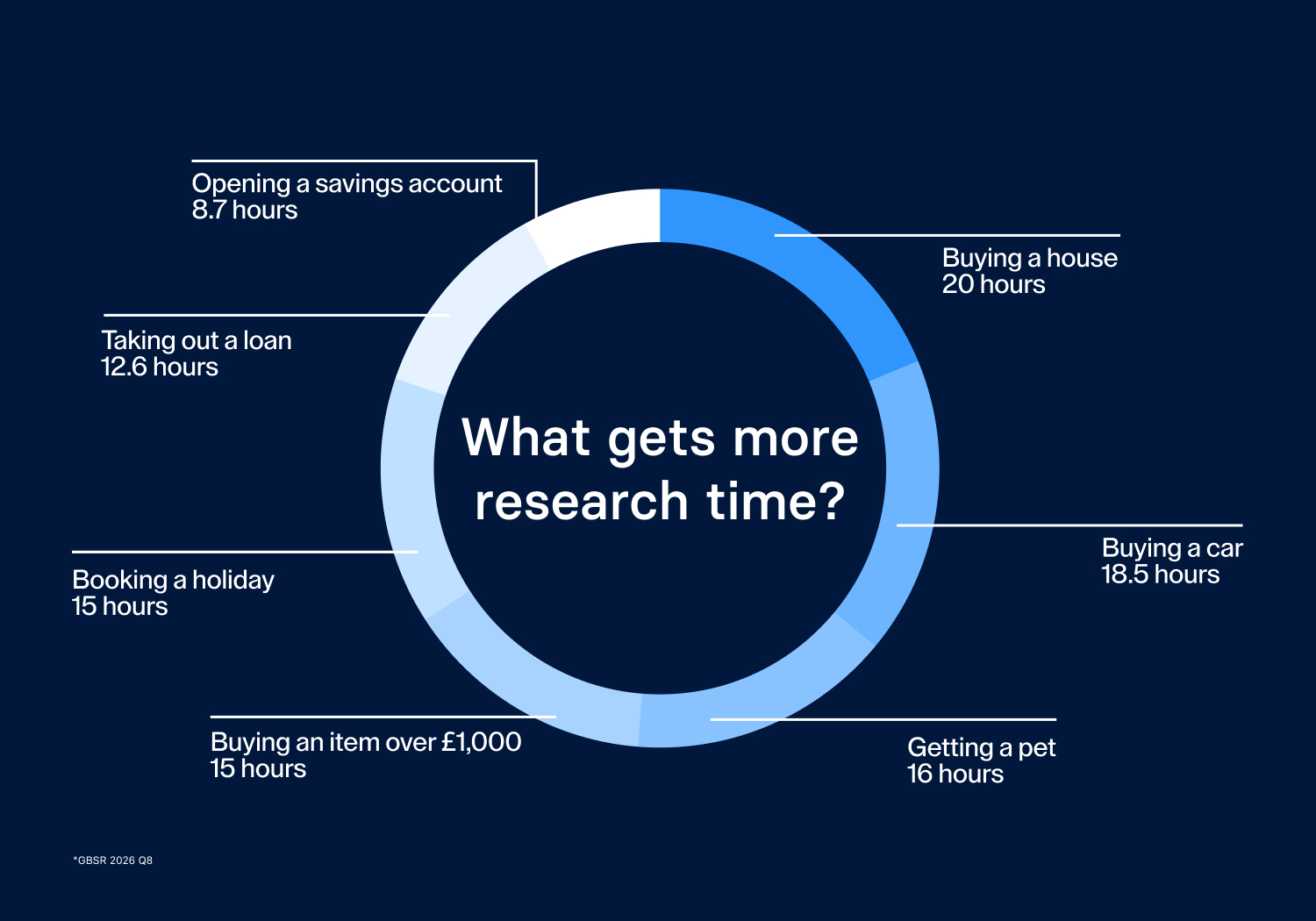
We spend considerably longer researching a holiday than a savings account
People report spending around 8.7 hours researching a savings account, compared with 15 hours booking a holiday. That means people spend considerably longer choosing a holiday than deciding where to put their savings.
That gap is particularly interesting because a savings account can shape both the return someone earns and how easily they can access their money.
Greater digital access has not removed all of the complexity either. Around one in five people say they find it difficult to compare account types, compare rates, understand the interest they will earn or judge whether a rate is competitive.
What gets more research time?
What does the Great British Savings Report tell us?
Fifteen years into the era of banking apps, money is easier to see, move, and manage. But the findings suggest the next stage of digital saving is about more than convenience.
People are saving less each month, more are drawing on their existing pots and access to cash is becoming more important. At the same time, savers are navigating new choices around ISAs, investing, retirement, and technology.
The next challenge is not simply making money easier to access, but making the available choices easier to understand.
“Checking your money and improving your money are not the same thing. A banking app can show you a balance instantly, but the next step is deciding whether your savings are still doing the job you need them to do.”
Kevin Mountford, personal finance expert and co-founder of Raisin UK
Frequently asked questions about UK savings in 2026
How much are people saving each month in the UK in 2026?
Among people currently saving for something in Raisin UK’s Great British Savings Report 2026, the reported average is £245 a month, down from £335 in 2025, a fall of 27%.
How many people dipped into their savings in the past year?
Nearly two-thirds (64%) of people with savings accounts say they dipped into them in the past year, up from 59% in 2025. Among those who did, the most commonly selected reason was everyday living expenses such as groceries and bills.
How much emergency savings should you have?
There is no single amount that suits everyone. MoneyHelper uses three to six months of essential outgoings in an instant-access savings account as a general rule of thumb. The right buffer will depend on individual circumstances.
What is the Cash ISA limit from April 2027?
From 6 April 2027, the annual Cash ISA allowance will drop to £12,000 for people under 65, while the overall annual ISA allowance (including Stocks & Shares ISAs) remains £20,000. People aged 65 and over will retain a £20,000 Cash ISA limit.
How does the State Pension fit into retirement income?
Two-thirds (66%) of respondents do not believe the State Pension alone will fund the retirement lifestyle they want. However, it remains the most commonly selected expected retirement income source.
Do banking apps make people better savers?
The research suggests digital banking is more likely to prompt people to monitor their money than make active savings decisions. While 39% say it makes them more likely to check how much money they have, only 15% say it makes them more likely to move savings to a better-paying account.
Can AI savings tools help people compare savings accounts?
AI-powered savings tools could help make comparison faster, but trust and transparency matter. In Raisin UK’s 2026 research, 21% said they would be more likely to trust an AI savings comparison tool if they could verify the results themselves, while 18% wanted human expert review or support. More than a quarter (27%) said nothing would make them trust one.
The findings suggest that people want AI tools to support comparison rather than replace their own judgement, with clear explanations, visible fees and restrictions, and the ability to check recommendations before acting.
Methodology
The 2026 Great British Savings Report research was conducted by Opinion Matters among 2,000 nationally representative UK adults aged 18 and over, with fieldwork from 1 to 3 September 2026.
Question 1, on savings account use, was rerun among a separate nationally representative sample of 2,000 UK adults from 11 to 14 September 2026, with short descriptions added to clarify the account types. All Q1 figures in this report use the rerun results.
Year-on-year comparisons are included only where question wording and response formats remain materially comparable.
This report is for general information only and does not constitute financial, investment or tax advice. Tax treatment and allowances may change, and investments can fall as well as rise in value.
Read previous Great British Saving Reports
If you're curious to see how Britain's savings habits have changed, take a look at our previous Great British Savings Reports using the links below.

About us
Savings accounts
Guides
About us
Savings accounts
Guides
All interest rates displayed are Annual Equivalent Rates (AER), unless otherwise explicitly indicated. The AER illustrates what the interest rate would be if interest was paid and compounded once a year. This allows individuals to compare more easily what return they can expect from their savings over time.
Raisin UK is a trading name of Raisin Platforms Limited which is authorised and regulated by the Financial Conduct Authority (FRNs 813894 and 978619). Raisin Platforms Limited is registered in England and Wales, No 11075085. Registered office: Cobden House, 12-16 Mosley Street, Manchester M2 3AQ, United Kingdom. The information on this website does not constitute financial advice, always do your own research to ensure it's right for your specific circumstances. Tax treatment depends on the individual circumstances of each customer and may be subject to change in the future.