Morgan Stanley
5.30 %AER

Bank
Interest rate
Duration · Deposit guarantee
Interest earned
: A 2 year fixed rate bond pays a competitive fixed interest rate that’s typically higher than what you would earn from an ISA or easy access account, though fixed ISAs may offer comparable tax-free returns depending on your tax bracket
: In exchange for a higher interest rate, you’ll need to lock away a lump sum for two years, during which time you won’t be able to top up your initial deposit or withdraw from it (so make sure you won’t need access to these funds for emergencies)
: All of the 2 year fixed rate bonds available through Raisin UK are protected under the Financial Services Compensation Scheme (or its European equivalent) up to £120,000 per person, per banking institution
The amount you can earn with a 2 year fixed rate bond depends on the interest rate on the savings account, and how much you can deposit. This table illustrates how much you could grow your initial deposit over a two year term with different savings amounts at different AERs. These figures are based on 2 year bonds paying interest in full on maturity, rather than crediting interest after a year.
*Rates are for illustrative purposes only and are not related to actual savings accounts from the Raisin UK marketplace.
£5,000 | £5,470 | £5,525 | £5,580 | £5,636 |
£10,000 | £10,940 | £11,049 | £11,160 | £11,272 |
£15,000 | £16,410 | £16,574 | £16,740 | £16,907 |
£20,000 | £21,880 | £22,099 | £22,320 | £22,543 |
A 2 year fixed rate bond is a savings account that locks in a fixed interest rate for 24 months. You deposit a single lump sum when opening the account. In exchange for fixing the rate, you can’t access or withdraw your money until the term ends.
You can open a 2 year fixed rate bond with one lump-sum deposit, which you can make with multiple transfers at Raisin UK. Once your savings account is open, you can’t make any further deposits or withdraw your money for 24 months.
It’s a simple way of ensuring you get the results you want from your savings in the medium-term, as you’re locked in for two years. If locking your money away for two years doesn’t sound right for you, fixed rate bonds are also available with six month, one year, three year and five year terms, or you could consider more flexible savings accounts, like easy access and notice accounts. Simply choose the savings account that best suits your goals.
Yes, a 2 year fixed rate bond is the same as a 2 year savings bond. This type of savings account goes by several different names. You may hear a fixed rate bond called a fixed term deposit, fixed rate savings, fixed term savings, savings bonds or a fixed rate savings account.
You open a 2 year fixed rate bond by depositing a single lump sum. Your money earns a set interest rate for exactly 24 months. During this time, you can’t make additional deposits or early withdrawals. Once the term matures, you receive your initial deposit plus all accrued interest.
Most 2 year fixed rate bonds have a minimum deposit amount, typically between £500 and £1,000. There’s also a maximum deposit amount, which for some savings account service providers can go into the low millions. At Raisin UK, the maximum we’ll allow you to deposit is £120,000 per bank to ensure that your deposit has FSCS protection.
It is possible to apply for any number of fixed rate savings accounts, but keep in mind that deposit protection limits apply to the banking group that holds your money, rather than the individual savings account.
2 year fixed rate bonds can be a great short-term investment option if you don’t want to risk investing your money, which could mean you get back less than you put in. Bonds usually offer more competitive interest rates than most other savings accounts, but they do require you to go without access to your cash for 24 months.
Ultimately, the deciding factors when it comes to 2 year fixed term savings accounts are whether you can go without your money for that length of time, and the rate of return.
Comparing term lengths can help you understand how your choice affects your money. Here is a breakdown of how a one year term could compare to a two year term to help you choose the right account.
Feature | 1 year fixed rate bond | 2 year fixed rate bond |
Term length | 12 months | 24 months |
Interest rate | Currently offers up to 5.20% | Currently offers up to 5.30% |
Access to funds | You cannot withdraw your deposit for one year | You cannot withdraw your deposit for two years |
Best suited for | Shorter-term plans where you need your money back sooner | Medium-term goals where you want rate predictability for longer |
Yes. At Raisin UK we offer a range of different terms from our trusted partner banks, ranging from six months to five years. Click on the cards below for more information.
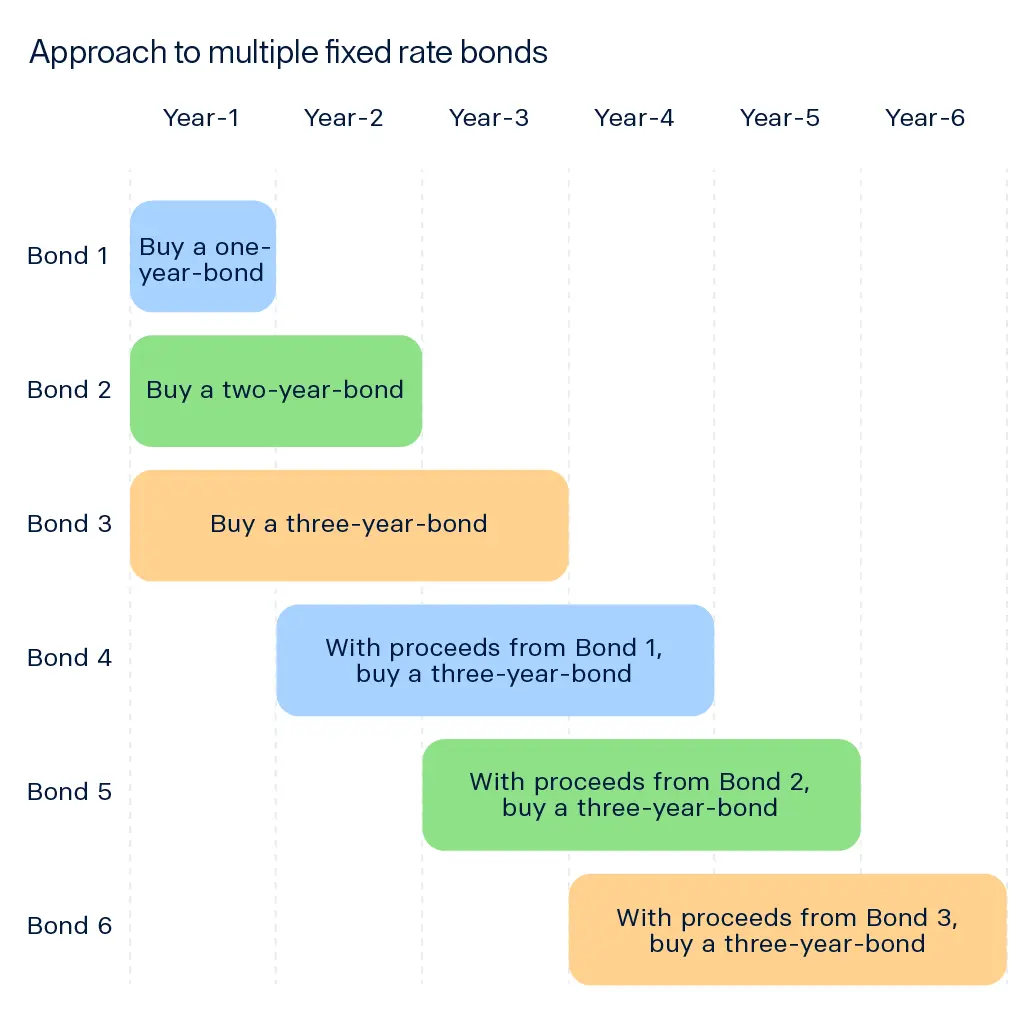
Some savers find it beneficial to to open several fixed rate bond accounts with different terms to benefit from compound interest. This is demonstrated in the table:
If you’re looking for a medium-term savings account and can lock away a lump sum for 24 months, 2 year fixed rate bonds offer the following benefits:
The interest rate is fixed for two years
You know how much interest you’ll earn upfront
You know exactly how long your term is and you can plan accordingly
Your money is protected from interest rate changes
While 2 year fixed rate bonds offer rate stability, they might not suit every savings goal. It is important to weigh the potential drawbacks before you lock your money away:
Fixing your interest rate gives you 24 months of predictable returns. However, if inflation remains high, the real value of your savings may still erode over time. Fixed rate bonds can often provide higher interest rates than easy access accounts and ISAs, helping you boost your savings over a two-year period, though fixed-rate ISAs may provide better net returns for those exceeding their Personal Savings Allowance.
The amount of interest you earn with a 2 year fixed rate account is advertised as an annual equivalent rate (AER). How much you can earn depends on the following:
How long your fixed rate lasts for, i.e. two years
The amount you deposit
The annual equivalent rate (AER)
How the bank pays interest
If you’re a basic rate (20%) taxpayer, you can earn interest of up to £1,000 per year without paying tax. This amount is reduced to £500 if you pay tax at the higher rate (40%).
How you earn interest from a 2 year fixed rate bond depends on which bond you open and which bank is offering the account. At Raisin UK, the interest you earn from a fixed rate bond will usually be paid to you upon maturity at the end of your fixed term, regardless of how frequently you earn it. Note that if interest compounds and is paid in full at maturity, the total accrued interest is treated as income in that specific tax year. This may cause you to exceed your Personal Savings Allowance in year two.
You can view how often you’ll earn interest and when it will be paid to you by reading the product summary of any savings account you want to apply for.
To find the best interest rate on 2 year fixed rate bonds, you could refer to any online comparison table or do some research into which institution is offering the best rates at this time. As part of your research, always check for FSCS protection and any minimum deposit requirements. It’s always important to read the fine print before signing up to any financial product.
Raisin UK works with a range of partner banks to offer competitive rates on 2 year fixed rate bonds. The current top rate available on a 2 year fixed rate bond via Raisin UK is 5.30%.
Our marketplace provides a choice of 2 year fixed rate savings accounts from UK banks, all of which are free to open. Read our handy guide to opening a fixed rate bond for more information and learn how to find the best fixed rate bond for you depending on your financial situation, savings goals, timeframe and deposit size.
If you’re looking for a savings account with a little more flexibility, consider exploring easy access or notice accounts from our partner banks.
At Raisin UK, you can apply for and manage savings accounts from a range of partner banks in one place. Simply click to apply and forget about the hassle of filling in a new application form for every savings account you open. Register for a free Raisin UK Account to easily grow your savings.
As you can’t top up a bond, you’ll need to deposit a lump sum at the beginning. The required deposit amount is usually £1,000 or more, depending on the account you choose. The more money you can afford to lock away, the more interest you’ll earn by the end of your term.
The two year term is one of the most important considerations you’ll have for a fixed term savings account, but don’t forget you’ll also need to think about:
The amount you can deposit
Deposit deadlines
The frequency with which interest is earned
How much of your money is protected
Tax implications
Yes, the interest you earn on a 2 year fixed rate bond is taxable if it exceeds your personal savings allowance (PSA). Basic rate (20%) UK taxpayers can earn up to £1,000 in savings interest tax-free each year, while higher rate (40%) taxpayers have a £500 tax-free allowance. However, additional rate (45%) taxpayers don’t receive a PSA, meaning that all of the interest you earn will be subject to tax.
All 2-year fixed rate bonds available via our platform are fully protected by the Financial Services Compensation Scheme (FSCS) up to £120,000 per person, per institution. The scheme offers deposit protection on savings accounts from regulated banks in the UK, including 2 year fixed rate bonds. The FSCS will cover deposits up to the £120,000 limit, including any interest, if your bank fails.
All of the fixed rate savings accounts from UK banks that you can apply for through our marketplace offer FSCS protection. The European Deposit Guarantee Scheme (DGS) covers savings accounts offered by European banks via our platform.
When your 2 year fixed rate bond matures at the end of the term, you have three options. You can withdraw your original deposit and accrued interest, transfer the funds to a different savings account, or reinvest your money into a new bond.
Discuss your options with your provider when your bond is coming to an end and explore the interest rates available to you.
When you reach the end of your term, this means your bond has matured. With a 2 year bond, the bank will usually contact you as you get closer to the maturity date. You’ll be asked what you wish to do with the money, either via a form or by confirming your choice online. If you want to withdraw your original deposit, you’ll typically get the money within a few days.
You typically only pay money into your fixed rate bond when you open the account, as you can’t normally top them up. Your initial deposit is usually made by bank transfer, which you can do online or from your branch.
Not normally. 2 year fixed rate bonds (and all other types of fixed term bonds) usually require you to make your full deposit when you open your account. If you’re looking for a savings account that you can regularly top up, you might want to consider notice accounts or easy access savings.
You can have as many 2 year fixed rate bonds as you like. You will need to keep in mind your personal savings allowance to ensure that you pay the right amount of tax and declare any excess.
Sometimes, but there will probably be a cost. Any fixed rate bond account that lets you withdraw money early will usually charge you a fee for doing so, which could wipe out your interest.
Yes. Fixed rate bonds carry very little risk when compared with alternative investment options, and you have a guaranteed return on your investment.
No. With most fixed rate bonds, up to £120,000 of your money is protected with the FSCS. You can check that your financial institution offers this protection by searching for them on the FCA Register.
If you’re looking for something similar to a 2 year fixed rate savings account, you’ll likely suit the low-risk, interest earning benefits offered by notice accounts and easy access accounts.
The exact amount of interest you will earn depends on the rate offered by a specific bank. Walking through an example can help you understand how interest on these bonds works.
Assuming you deposit £10,000.00 into an account offering a competitive 4.65% AER:
This calculation is for illustrative purposes only. Actual returns depend on the specific terms of the account and when the bank pays interest.

All interest rates displayed are Annual Equivalent Rates (AER), unless otherwise explicitly indicated. The AER illustrates what the interest rate would be if interest was paid and compounded once a year. This allows individuals to compare more easily what return they can expect from their savings over time.
Raisin UK is a trading name of Raisin Platforms Limited which is authorised and regulated by the Financial Conduct Authority (FRNs 813894 and 978619). Raisin Platforms Limited is registered in England and Wales, No 11075085. Registered office: Cobden House, 12-16 Mosley Street, Manchester M2 3AQ, United Kingdom. The information on this website does not constitute financial advice, always do your own research to ensure it's right for your specific circumstances. Tax treatment depends on the individual circumstances of each customer and may be subject to change in the future.