


More than 1 million savers worldwide

Home › Savings accounts › Fixed rate bonds › 1 year fixed rate bonds
A 1 year fixed rate bond is a savings account where you deposit a single lump sum and earn a fixed interest rate for one year. The rate will stay the same for 12 months, even if the Bank of England base rate or interest rates generally change. You typically cannot withdraw your funds or close the account before the end of the term.
You may hear fixed rate bonds referred to as fixed term deposits, fixed rate savings, savings bonds, or fixed rate savings accounts; these terms typically refer to the same type of savings account. You can also apply for fixed rate bonds with different terms, including six month, two year, three year and five year fixed rate bonds.
A 1 year fixed rate bond will typically give you a more competitive rate of return than other savings accounts, such as notice accounts or easy access accounts. Not sure which 1 year fixed rate bond is best for you? Comparing bonds from different providers can help you decide.
At Raisin UK, we provide an easy-to-use comparison table that lets you browse 1 year fixed rate bonds currently on offer from our partner banks and building societies. See how much you could earn after a year (please note: expected interest figures are illustrative only and rate dependent).
1 - Open your account: You open a 1 year savings account by depositing a single lump sum. Your money is then locked away for the full 12-month term, meaning you can’t access it until the bond matures.
2 - Check deposit conditions: 1 year fixed rate bonds typically require a minimum deposit of around £1,000, although this varies by account or provider (you can find out by checking the terms of the account). Eligible savings deposited with FCA-authorised banks and building societies are protected up to £120,000 per person, per bank, by the Financial Services Compensation Scheme (FSCS). At Raisin UK, you can only deposit an amount that’s within the applicable deposit protection limit.
3 - Earn interest on your savings: The amount of interest you could earn from a 1 year fixed rate bond is advertised as an annual equivalent rate (AER). How much you earn depends on a few things:
How much you deposit.
The annual equivalent rate (AER).
How the bank pays out interest.
4 - Consider tax on interest: Interest on a 1 year fixed rate savings bond is typically paid out on maturity, i.e. at the end of your one year term. Depending on how much you deposit and your individual tax rate, you may have to pay income tax. However, with the personal savings allowance (PSA), basic-rate taxpayers can earn up to £1,000 and higher-rate taxpayers can earn up to £500 tax-free per tax year.
Finally, there’s no limit to how many 1 year savings accounts you can open. Bear in mind, however, that FSCS protection applies per person, per bank, including any accounts held under different trading names of the same bank. This means any eligible savings exceeding £120,000 won’t be protected under the FSCS scheme if the bank fails.
At Raisin UK, your funds become available in your Raisin UK Transaction Account. From there, you have three options:
Renew your bond. If it’s an option offered by your partner bank, you can renew your bond with them. Some partner banks offer auto-renewal, in which case you’ll have another 1 year fixed rate bond with the same bank with no action required (provided you have the auto-renewal option switched on). Alternatively, you may be able to select a fixed rate bond with a different term from the same provider.
Open a new savings account. Use your matured funds to apply for a new fixed rate bond through the Raisin UK marketplace.
Withdraw your money. Move your deposit and any interest to your nominated bank account.
If you take out a 1 year fixed rate bond, you can only keep it for 12 months but you may be able to renew it before it matures. If your partner bank offers renewals, you’ll see a ‘See renewal options’ button in the ‘Details’ section within your Raisin UK Account. You can renew your bond up to one day before maturity, and your renewal will use the interest rate available.
If you take no action and the account has auto-renewal enabled (you can switch off auto-renewal in your account dashboard), your savings account will automatically renew into a 1 year fixed rate bond with the same partner bank, unless you cancel it at least one day before maturity.
Read more about fixed rate bond maturity and renewals.
With a 1 year fixed rate bond, you leave your money untouched for the duration of the term. Fixed rate bonds opened through Raisin UK do not operate on the basis that you can end your fixed term early and pay a fee to withdraw funds. If there’s a chance you’ll need to withdraw your money from your fixed rate bond before the end of the term, you might want to consider opting for a notice account or easy access account instead.
A 1 year fixed rate bond offers savers the chance to earn interest on their funds without having to lock them away for longer. But they aren’t the only fixed rate options available. If you’re looking for shorter-term savings, Raisin UK offers a variety of fixed rate bonds under 12 months. For longer-term options, explore the 2, 3, or 5 year fixed rate bonds.
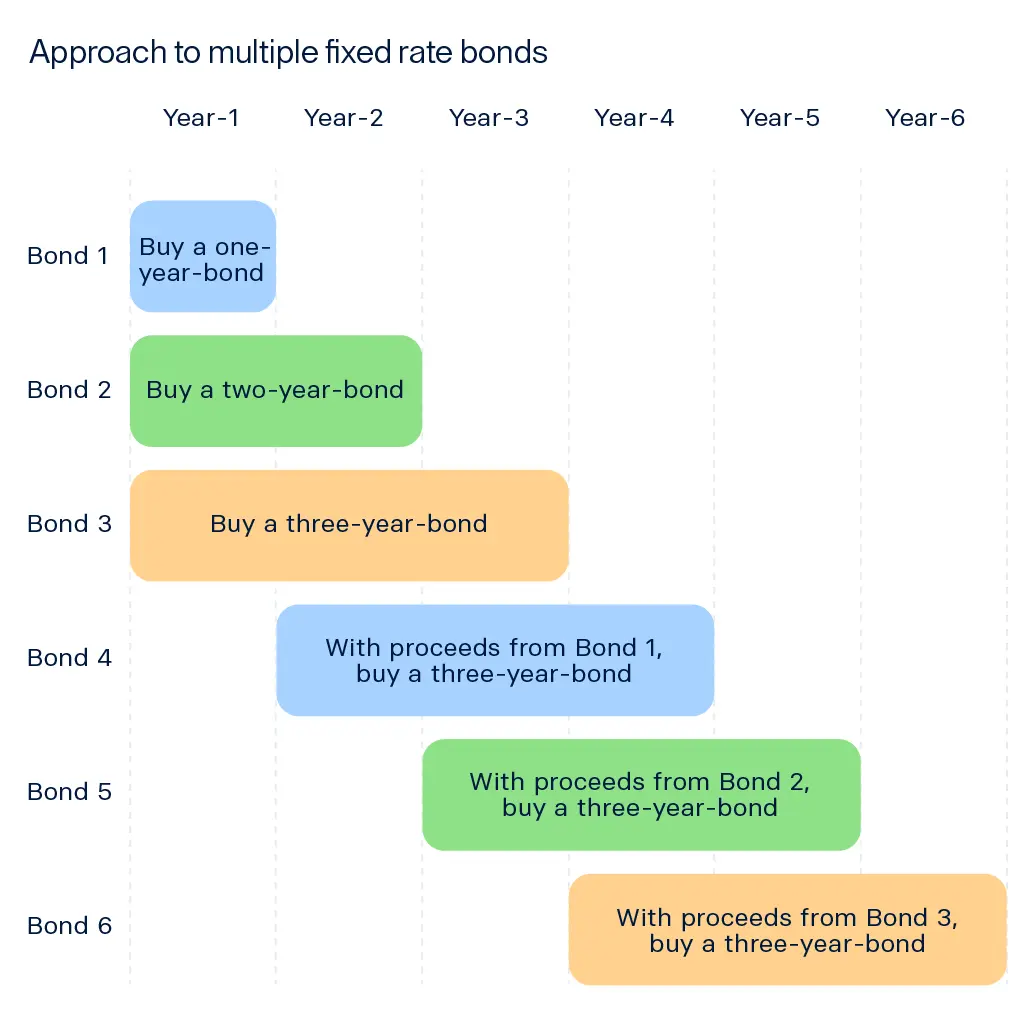
One approach some savers take is to apply for different lengths of fixed rate savings bonds to benefit from the interest and proceeds of each one. An example of this is demonstrated in the table:
1 year fixed rate bonds can be beneficial for those who are in a position to deposit a lump sum that they won’t need to access for 12 months:
Your interest rate is fixed for one year;
You are certain of the interest you’ll earn;
You know how long your savings period lasts for;
You can use them for one-year savings plans;
You can protect your savings from interest rate changes; and
Wondering which 1 year fixed rate bond might work best for your situation? This ultimately depends on your savings goals and how much money you’re able to lock away. You might consider the following questions:
Is the interest rate going to give me what I want? One of the advantages of fixed rate bonds is that you can calculate the amount of interest you’ll earn, and whether you’ll hit your savings target before you even open the account.
Do I have enough money to open a fixed rate bond? You need a lump sum to open a 1 year fixed rate bond, typically £1,000 or more, depending on the account you choose.
Register with Raisin UK to access 1 year fixed rate bonds from a range of FSCS-protected banks and building societies. It’s free to get started.
Have questions or need help? You can contact us.
Email: help@raisin.com
Phone: 0161 388 2399 (Monday to Friday, 8:30 am to 4:30 pm)
Alternatives to 1 year fixed rate bonds differ from person to person and depend on your individual savings goals. Options might include easy access accounts that offer immediate access to your cash (but potentially lower rates), or notice accounts, which offer a competitive interest rate and access to savings after providing a short period of notice.
Providing your financial institution is protected by the FSCS, up to £120,000 of eligible deposits are protected in the event of their failure. Fixed rate bonds present lower risk compared to some investment assets as you will get your money back, and a little bit extra, when they mature.
The interest earned on 1 year fixed rate bonds is taxable, but only when it exceeds your personal savings allowance. For basic rate taxpayers, this amount is £1,000 per tax year, while higher rate taxpayers have an allowance of £500.
The majority of 1 year fixed rate bonds only allow you to deposit money when you open your account. Accounts that you can top up include easy or instant access accounts, or regular savings accounts that allow you to pay money in regularly.
You will pay money into your 1 year fixed rate bond when you open it, in the form of a lump sum deposit. Most fixed rate bond accounts don’t allow you to add any more money once the account is set up.
There’s no limit to how many fixed rate bonds you can open, but it’s important to keep your personal savings allowance (and FSCS deposit protection) in mind, because you’ll need to declare any amount that goes over it to HMRC. Some people take a strategic approach to saving by opening fixed rate bonds of different terms, as we explored in the table.
Financial institutions authorised by the Financial Conduct Authority are part of the FSCS, which means that eligible deposits are protected up to £120,000 per person, per bank. You can check that your institution offers the protection by searching for them on the FCA Register.
What’s in it for me?

All interest rates displayed are Annual Equivalent Rates (AER), unless otherwise explicitly indicated. The AER illustrates what the interest rate would be if interest was paid and compounded once a year. This allows individuals to compare more easily what return they can expect from their savings over time.
Raisin UK is a trading name of Raisin Platforms Limited which is authorised and regulated by the Financial Conduct Authority (FRNs 813894 and 978619). Raisin Platforms Limited is registered in England and Wales, No 11075085. Registered office: Cobden House, 12-16 Mosley Street, Manchester M2 3AQ, United Kingdom. The information on this website does not constitute financial advice, always do your own research to ensure it's right for your specific circumstances. Tax treatment depends on the individual circumstances of each customer and may be subject to change in the future.

