

UBL UK
4.16 %AER

Home › Savings accounts › Fixed rate bonds › 5 year fixed rate bonds
: A 5 year fixed rate bond is a savings account that locks your money away for five years in exchange for a competitive, fixed rate of interest
: Bear in mind that you may not be able to access your money during the five year term or, if you can, you’re likely to incur a penalty
: How much interest you’ll earn depends on the annual equivalent rate (AER), how much you deposit and the way the bank calculates interest
A 5 year fixed rate bond is a savings account where you deposit a lump sum at a fixed interest rate for 5 years, regardless of Bank of England base rate changes.
If you’re wondering whether to open a 5 year fixed rate bond, the answer really depends on your personal circumstances and your saving goals, especially if you have a 5 year savings plan.
If you have a lump sum that you can lock away for five years, a 5 year fixed rate bond (also known as a 5 year fixed term deposit) might be right for you, especially if you’re looking for a savings account with a fixed interest rate that’s typically higher than you might earn from an ISA or easy access account.
While five years can seem like a long time to lock a lump sum of money away, it does come with the added bonus of not having to worry about fluctuating interest rates, as they won’t affect you. Your money can be out of sight, out of mind, and earning you a solid return. A 5 year fixed savings account might be right for you if you meet the following criteria:
You open a 5 year fixed rate bond with a lump sum deposit that you lock away to earn a fixed interest rate for a full five year term, meaning that you won’t be able to access these savings until the five-year term elapses, you typically can’t withdraw your money before the end of the fixed term and you can’t make further deposits once your term begins.
As you’re locking your savings in for five years, it’s important to find an account that earns as much interest as possible and suits any other requirements you may have.
Most fixed rate savings accounts require a minimum and maximum deposit, typically somewhere between £500 and £2,000,000, although this will depend on the savings account provider.
Because deposit protection from the FSCS is only available on deposits of up to £120,000 per person, per bank, that’s the maximum we’ll allow you to deposit into a savings account.
A 5 year fixed rate bond is a good choice if you have a lump sum to stash away and want to earn more on your money than you would on a regular savings account.
The most important aspect is being confident that you can put the money aside and not touch it for the duration of the five year term. Maybe you’re someone who’s looking to protect and grow a lump sum of money over a longer period of time, as these longer-term bonds are good for those saving for a long term financial future.
How much interest you’ll earn from your 5 year fixed rate bond will depend on your initial investment and the AER (Annual Equivalent Rate) you sign up for. Getting the best rate on your 5 year fixed rate bond means mapping out your options and comparing the different offers on the market. Here are some common considerations when comparing fixed rate bonds.
At the end of your five year term, you may receive a renewal offer for a savings account with the same bank. If a renewal offer is available, you can choose whether to renew with your original deposit and any interest you’ve earned or just your deposit and withdraw your interest.
Alternatively, you can also choose to move your funds to a new savings account or withdraw your original deposit along with any interest earned and close the account.
Yes, at Raisin UK you can apply for the following fixed rate savings account terms:
You could consider opening fixed rate bonds of different terms. As you can see from the chart below, this gives you the opportunity to maximise the higher interest rates of longer-term bonds, while taking advantage of having an account mature every year.
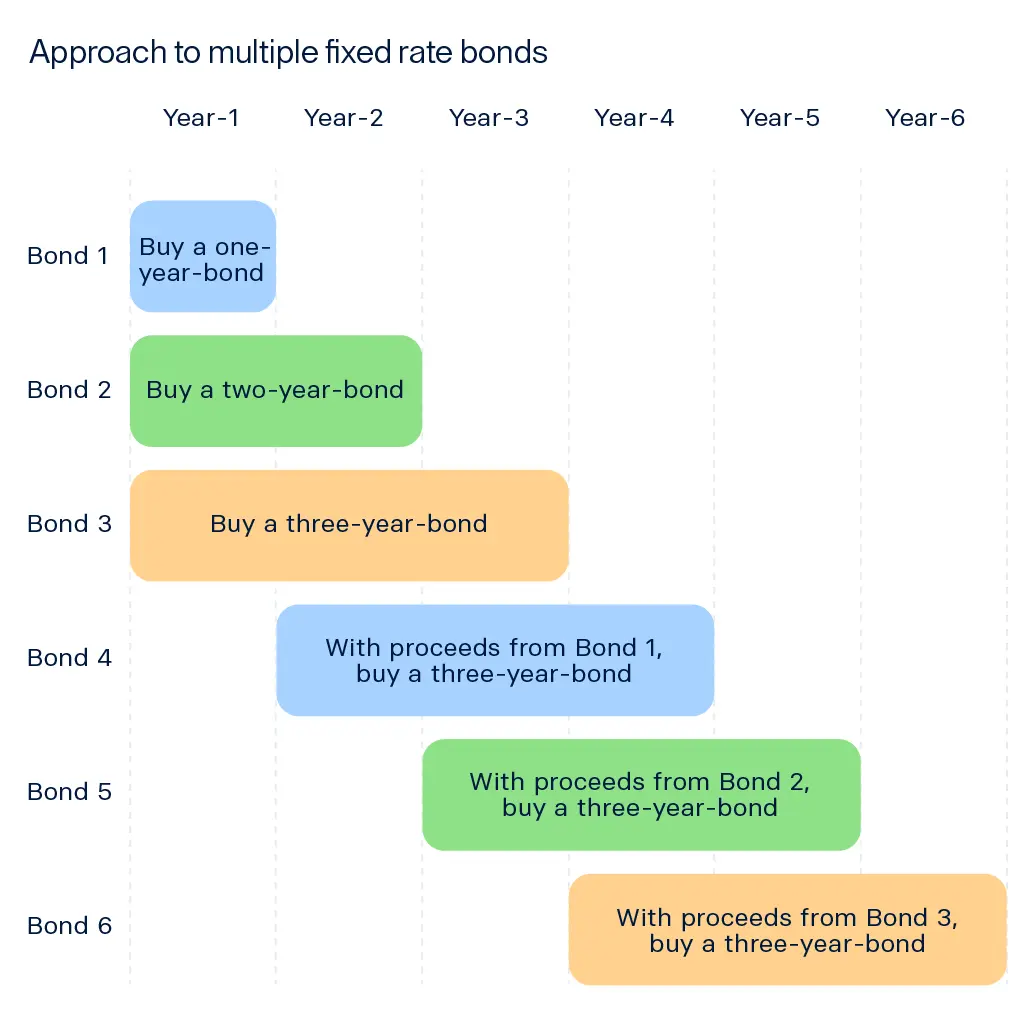
You could consider opening fixed rate bonds of different terms. As you can see from the chart, this gives you the opportunity to maximise the higher interest rates of longer-term bonds, while taking advantage of having an account mature every year:
You can choose from a range of 5 year fixed rate savings accounts from our partner banks in our online marketplace. Currently, the best interest rate for a 5 year fixed rate bond through our marketplace is 3.15% AER.
However, if you’re looking for a savings account with more flexibility, an easy access or notice account may be more suitable.
Our marketplace features a choice of savings accounts from different banks that are free to open and manage in one place; your Raisin UK Account. It only takes a few minutes to register, and once you’ve registered with us, you can apply for savings accounts in our marketplace in a few clicks.
Once your application has been approved, all you need to do is transfer your deposit, sit back and watch your savings grow.
You pay into your 5 year fixed rate bond at the beginning of the term, and that’s it. Withdrawals and additions aren’t usually allowed, so this initial investment is what you’ll be working with. If you’re ready to invest, it’s a simple process. You add the money, you leave it alone for the full term, and it has the chance to grow and earn you even more money.
Yes, as long as you open an account with a UK-regulated provider that offers deposit protection. Protecting your money is one of the most important aspects of a 5 year savings plan. Your deposit is protected by the FSCS for up to £120,000. This amount is per banking group and per person.
When you commit to a fixed rate bond, you agree to lock your money away for a fixed term. Before opening a fixed rate bond, it’s important to consider that should you want to withdraw money, you may not be able to do so, or you may face penalty charges.
Most providers require a single lump-sum deposit when you open a fixed rate bond and won't allow further contributions during the term. You may have a short funding window to deposit your lump sum after opening the account. If you want to make monthly contributions, an easy access savings account might suit you better.
If you have savings in an easy access account, you can usually withdraw them to deposit into your chosen 5-year fixed-rate bond. For savings in a notice account, you’ll need to serve the required notice period first. If your funds are currently in another fixed-rate bond, you’ll need to wait for that account to mature before moving the money.
Generally, you cannot withdraw funds from a fixed rate bond before the term ends. If a provider does allow early access, they may charge a fee or pay interest on a pro-rata basis. It’s important to check the specific terms and conditions of your chosen account for full details.
Some providers offer 5 year fixed rate bonds within an ISA wrapper. However, we don't offer ISA products at Raisin.
Yes. With Raisin, you can compare and open 5 year fixed rate bonds from multiple providers and manage them all with a single log-in.
Interest earned on a 5-year fixed-rate bond may be subject to tax if the total interest you’ve earned over a tax year exceeds your Personal Savings Allowance (PSA).
The current allowances per tax year (as of 2025/26) are:
Savings interest is taxed based on your standard income tax rate.

All interest rates displayed are Annual Equivalent Rates (AER), unless otherwise explicitly indicated. The AER illustrates what the interest rate would be if interest was paid and compounded once a year. This allows individuals to compare more easily what return they can expect from their savings over time.
Raisin UK is a trading name of Raisin Platforms Limited which is authorised and regulated by the Financial Conduct Authority (FRNs 813894 and 978619). Raisin Platforms Limited is registered in England and Wales, No 11075085. Registered office: Cobden House, 12-16 Mosley Street, Manchester M2 3AQ, United Kingdom. The information on this website does not constitute financial advice, always do your own research to ensure it's right for your specific circumstances. Tax treatment depends on the individual circumstances of each customer and may be subject to change in the future.


