
Compare short term savings accounts
Fixed rate bonds, notice accounts, and easy access accounts for different savings goals
Home › Savings accounts › Short term savings accounts
With a short term savings account, you can deposit your money for a short amount of time – anything from three months to one year. Depending on the account type, you might still have access to these funds if you need to withdraw money. Compare rates for short term savings accounts through Raisin UK (including easy access accounts and fixed rate bonds under 12 months) and see whether they fit your savings goals.
The information provided here is for informational and educational purposes only and does not constitute financial advice. Please consult with a licensed financial adviser or professional before making any financial decisions. Your financial situation is unique, and the information provided may not be suitable for your specific circumstances. We are not liable for any financial decisions or actions you take based on this information.
What is a short term savings account?
A short term savings account usually refers to a type of savings account where your money stays in an account for a short period of time. This allows your savings to accumulate interest but doesn’t lock your funds away for a long amount of time.
Stashing away money for a lengthy period of time may not be a saver’s first choice for all their money goals. Some people prefer to mix longer-term savings with a pool of funds that are readily available if needed.
Short term savings accounts come in different shapes and forms – from a 6 Month Fixed Rate Bond, to easy access accounts and notice accounts. These accounts have varying rates of interest and different withdrawal rules, so it can be worth comparing the details of each account.
What are the types of short term savings accounts?
Fixed rate accounts
Fixed rate savings accounts allow you to lock your money away for a fixed period of time at a fixed interest rate. Once you have deposited your lump sum, you won’t be able to add or withdraw any money until the term ends. Some banks and financial institutions will grant access before maturity but this usually incurs a penalty.
At Raisin UK, we offer a variety of term lengths for shorter or longer-term goals:
3 Month Fixed Rate Bonds
7 Year Fixed Rate Bonds
Easy access savings
Easy access savings accounts allow you to deposit money and earn interest with the benefit of retaining access to your funds. While the interest rates are variable, and may be lower than those offered on a more restrictive savings account, you can generally withdraw or add funds to your account without facing a penalty (although conditions vary by provider). There may still be some rules and regulations around how and when you can withdraw your funds, but these rules tend to be more flexible than fixed rate accounts.
Notice accounts
Notice accounts allow you to put away your savings, earn interest, and still be able to withdraw money as long as you give your bank or building society notice. The notice period to withdraw money is usually between 30 and 120 days, depending on the account and the individual regulations of the bank. These kinds of accounts tend to have variable interest rates, which means that the interest level could go up or down in line with market conditions and other factors.
What terms are available for savings accounts?
The term you choose depends on your financial goals and whether you may need access to your savings during the agreed term. Most savings accounts in the UK let you choose between:
Savings accounts and individual savings accounts (ISAs) with no fixed terms, allowing for relatively quick and easy withdrawals and top-ups (sometimes instant access)
Short-term accounts with terms that run from three months to one year, and;
- Longer-term accounts, which usually last for between two and five years and may offer higher interest rates in return for locking in your funds.
What is the difference between a short term and long term savings account?
The distinguishing feature with short term savings options is the ease with which you can access your funds – whenever you want or after a brief period. Other differences are shown in the table below. Please note that interest rates can change and are not guaranteed:
Typical term length | 3 months to 1 year (or no fixed term) | 2 to 5 years (sometimes longer) |
Access to funds | Often flexible – especially with easy access accounts | Locked in for the full term; early withdrawals may not be allowed or could incur penalties |
Interest rates | Usually lower than long-term accounts | Generally higher, as you commit your money for longer |
Example savings goals | Near-term goals like a holiday, or an emergency fund | Growing a lump sum for larger purchases, such as a mortgage deposit |
Risk of missing better rates | Easier to switch when better rates appear | Your savings are tied up for the duration of the term, so you might miss out if rates go up |
Example accounts | Easy access, notice, or fixed rate bonds under 12 months | Fixed rate bonds with 2, 3, or 5-year terms |
How is interest calculated?
The interest you receive from a savings account is typically shown as an annual equivalent rate (AER). The AER indicates how much interest you’ll earn over a full year after taking into account the effect of compounding, as well as any bonuses and charges. Because AER is a standardised indication of interest rates, the AER calculation makes it easier to compare savings accounts with different terms.
How much interest you’ll earn from a long or short term savings account depends on:
The length of your fixed term
Your deposit amount
The interest rate (AER)
How your bank calculates interest
You should also consider whether you’ll need to pay tax on any interest you receive.
Tax on interest from short term and long term savings accounts
The amount of tax you might have to pay on savings interest depends on how much interest you earn and your income tax band.
Thanks to the personal savings allowance, in the 2025/26 tax year, basic rate UK taxpayers can earn up to £1,000 in interest without paying tax, while higher rate taxpayers can earn up to £500 of tax-free interest. Any interest you earn above these limits will be taxed at your usual rate of income tax – so 20% for basic rate taxpayers and 40% for higher rate taxpayers.
Additional rate (45%) taxpayers do not receive a personal savings allowance, which means all interest is taxable.
What are the pros and cons of short term savings accounts?
It can be worth weighing up the pros and cons to decide whether a short term savings account is the best option for you.
Pros of a short term savings account
- Even for a short amount of time, keeping your savings in an account where it can accumulate interest can help your money grow.
Keeping your money in a savings account with limited access to your funds (even in the short term) might help prevent spontaneous spending. This is especially true with fixed rate accounts and notice accounts where you face a few more hurdles to access your money in comparison to an easy access account.
- Another advantage of a short term savings account is flexibility: you can choose which kind of account and the level of access you want. If you’re able to lock away your savings, some accounts come with heightened restrictions in return for potentially higher interest rates. Alternatively, an easy access account offers more freedom and flexibility. Because these accounts are short-term, you can also potentially move your money to an account with a higher rate rather than getting locked into long term rates. Read more about why switching savings accounts can pay off.
Cons of a short term savings account
- One of the drawbacks of choosing a short term savings account is that the rates of interest are not usually as high as with longer-term accounts. Longer-term fixed rate bonds may offer higher rates, but not always. . With notice accounts, longer notice periods or tighter access conditions can sometimes mean higher interest rates (but variable rates can change at any time).
Picking a short term account imay mean moving your money around more often. This can be a benefit if you want to follow the best rates. However, it can also be a drawback in terms of the time and energy you may spend researching and finding the best rates on a regular basis.
At Raisin UK, you can quickly compare the rates on different savings accounts offered by our partner banks and building societies.
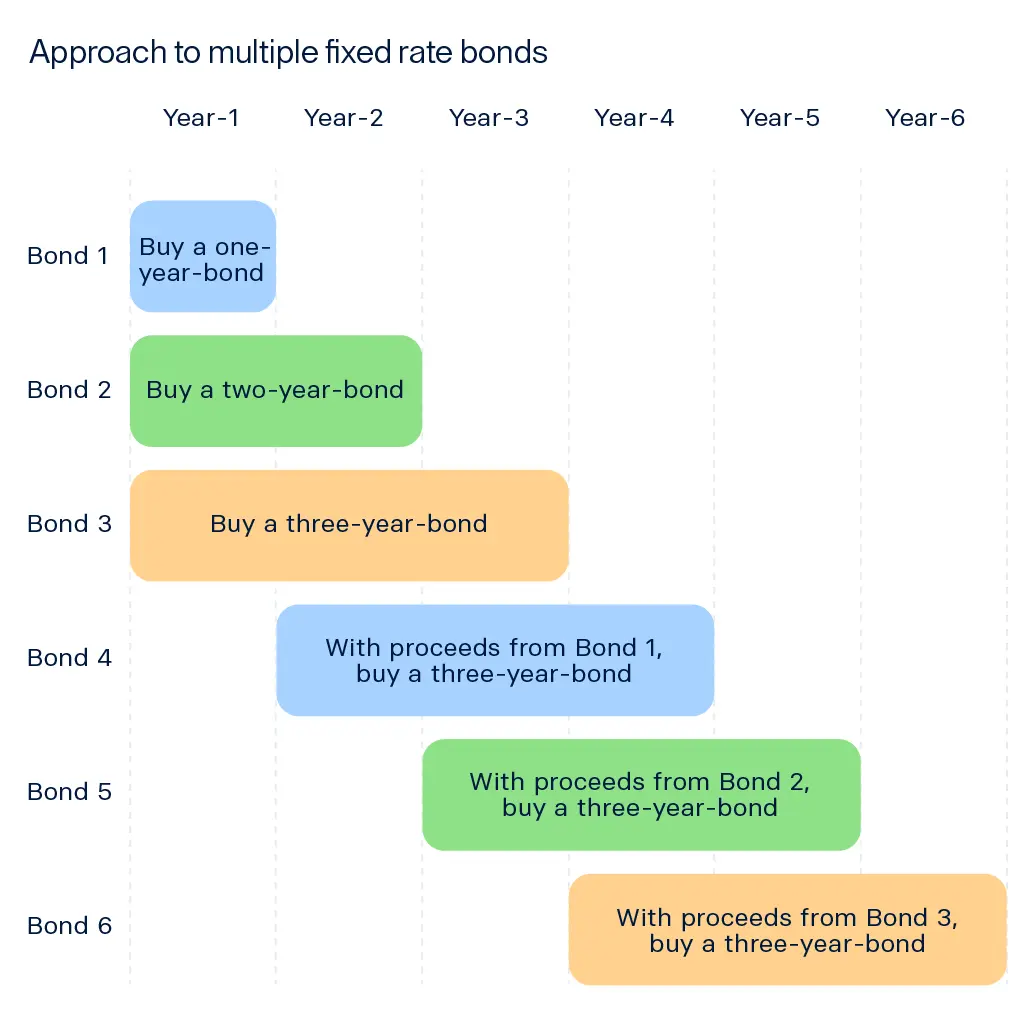
Should I have a long term and short term savings account?
It is possible to have more than one savings account. In fact, holding multiple savings accounts with different terms is one way to structure a savings portfolio (providing you won’t need access to the cash before the term ends).
The image shows how this might look. In year one you open three fixed rate bonds: a 1 year, 2 year, and 3 year fixed rate bond. Each year the shortest-maturity bond comes out and the funds are placed in a new 3 year bond, creating a ladder. This means that a portion of your funds becomes available every year which can either be taken out or locked in at longer-term rates. Please note, this example is for illustrative purposes only.
What should I consider when opening a short term account?
When opening a short term account, savers might consider which account is best suited to their needs in the short term. Here are some considerations:
- How long you can afford not to have access to your money
- Whether you want to be able to add or withdraw money during the term
- Which account provides competitive interest rates
When opening any kind of savings account – both long and short term – savers might compare interest rates and offset that against the terms and conditions being offered.
Is my money secure in a short term savings account?
Under the Financial Services Compensation Scheme (FSCS), eligible deposits with UK-regulated banks are protected up to £120,000 per person, per bank. This amount doubles to £240,000 if you own a joint account.
Savings accounts through the Raisin UK marketplace have a maximum deposit amount of £120,000, so eligible funds within this amount are protected under the UK compensation scheme.
How to open a savings account with Raisin UK
- Register for a Raisin UK Account. It’s free to sign up.
- Complete the verification process.
- Log in and choose an account. Browse the Raisin UK marketplace and choose a short term or longer term savings account that suits your goals.
- Carefully read the terms and conditions to ensure you’re happy with the deposit amount, term (if applicable), and interest rate.
- Transfer your deposit.


Save smarter with the Raisin UK newsletter!
What’s in it for me?
Receive exclusive updates on market-leading rates
Ensure you never miss a bonus offer
Keep your finger on the pulse with the latest financial news
Find out more about savings accounts

About us
Savings accounts
Guides
About us
Savings accounts
Guides
All interest rates displayed are Annual Equivalent Rates (AER), unless otherwise explicitly indicated. The AER illustrates what the interest rate would be if interest was paid and compounded once a year. This allows individuals to compare more easily what return they can expect from their savings over time.
Raisin UK is a trading name of Raisin Platforms Limited which is authorised and regulated by the Financial Conduct Authority (FRNs 813894 and 978619). Raisin Platforms Limited is registered in England and Wales, No 11075085. Registered office: Cobden House, 12-16 Mosley Street, Manchester M2 3AQ, United Kingdom. The information on this website does not constitute financial advice, always do your own research to ensure it's right for your specific circumstances. Tax treatment depends on the individual circumstances of each customer and may be subject to change in the future.