
What is laddering?
The savings technique balancing access with returns
Looking for a way to balance access to your savings with competitive interest returns? The savings laddering technique, also known as laddering, offers a structured approach to manage your funds over time. By using staggered fixed rate bonds, savings ladders can provide a blend of flexibility and growth.
Key takeaways
Laddering allows regular access to maturing funds, rather than locking away your entire balance
Laddering balances returns with liquidity through staged fixed rate bond terms
This approach could suit savers planning for long-term goals without giving up flexibility
The information provided here is for informational and educational purposes only and does not constitute financial advice. Please consult with a licensed financial adviser or professional before making any financial decisions. Your financial situation is unique, and the information provided may not be suitable for your specific circumstances. We are not liable for any financial decisions or actions you take based on this information.
What is a savings ladder, and how does it work?
A savings ladder involves splitting your money across several fixed-rate savings accounts with different maturity dates, so they pay out at staggered points. This setup allows you to access portions of your cash regularly, rather than locking it all away at once.
A typical laddering strategy works by:
- Spreading deposits: Instead of depositing a lump sum into a single account, you might spread your deposit equally across five fixed rate bonds, maturing at one, two, three, four, and five years.
- Reinvesting funds: When the 1 year account matures, those funds might be reinvested into a new 5 year fixed rate bond, helping to keep the ladder going and providing opportunities for liquidity.
- Repeating the cycle: You can keep saving into accounts with the longest term available as each bond matures, creating a continuous cycle of yearly maturity.
This method could also help manage the impact of changing interest rates, as your funds aren’t committed all at once.
How to build a savings ladder
Let’s say you’ve set aside £25,000 for saving. You could divide this into five equal parts of £5,000 and place each into fixed rate bonds with different terms: one, two, three, four, and five years.
Once the 1-year bond reaches the end of its term, you might choose to save those funds into a new 5-year bond. In year two, the original two-year term matures and can again be rolled into a new 5-year bond. This annual rotation helps to keep your ladder going, while gradually shifting more funds into longer-term solutions.
Here’s an example:
- Year 1: Invest into five bonds with terms from one to five years
- Year 2: Reinvest matured funds into a new 5-year bond
- Year 3 and beyond: Repeat the process as each bond matures
Over time, this leads to a steady structure where one bond matures annually. It can help balance access to cash with the potential for higher interest rates through longer-term saving. Even if interest rates stay flat, this approach might support long-term financial planning.


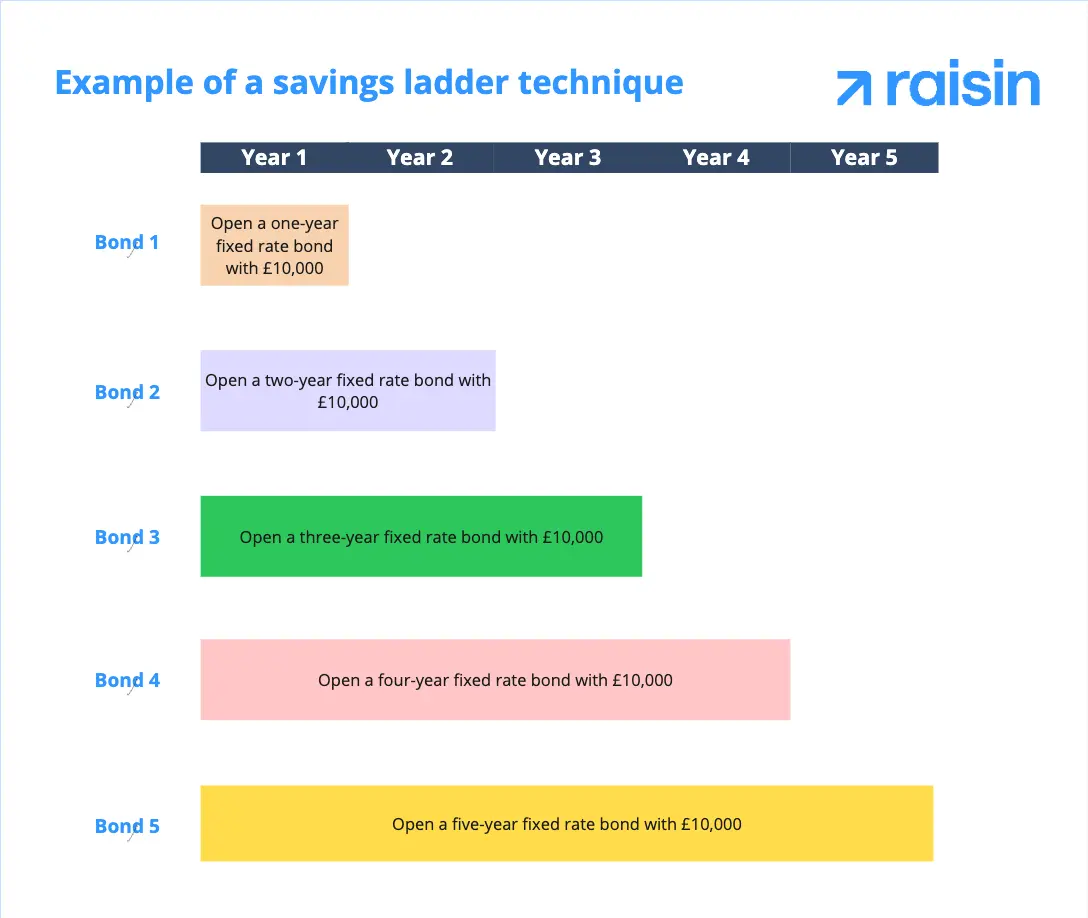
Example of a five-year savings ladder
Here’s an example of how a five-year laddering structure with a starting deposit of £50,000 could work.
- Split the savings: Divide the total evenly into five parts of £10,000.
- Stagger the terms: Place each portion into a fixed rate bond. They should mature in one, two, three, four, and five years. This creates a structure where one bond reaches maturity each year.
- Reinvest as bonds mature: When the 1-year bond matures, save it into a new 5-year bond. This helps maintain the ladder over time. If you need access to the cash, withdraw your savings instead.
- Create a rolling structure: By repeating this process each year, your savings will sit across five-year accounts with staggered start dates, with one portion becoming available annually.
This rolling structure means one portion becomes available yearly, which can support both consistent access and increased income potential if interest rates rise, without locking away your entire balance at once.
What are fixed rate bonds and why are they used in a savings ladder?
Fixed rate bonds are savings accounts that have a set interest rate for a specified term, usually between six months and five years. They are also known as fixed rate savings accounts, fixed term deposits or lump sum savings accounts. Fixed rate bonds can be a useful way to access the higher interest rates that may be associated with longer-term saving. However, it’s important to understand that access to your money is limited until the end of the agreed term, which may affect your liquidity.
Fixed rate bonds are ideal for a savings ladder because they offer set terms. This means savings can be spread across different bonds with staggered maturity dates. The money can then be saved in a new bond to add another rung to the ladder, or withdrawn.
Interest earned will count toward your personal savings allowance, which determines how much interest you can earn tax-free on your savings each year, based on your tax band.
View and compare top fixed rate bonds to see available terms and interest rates.
Advantages of a savings ladder
Some advantages of using a savings ladder include:
- Higher interest rates: Longer-term savings accounts can sometimes offer more competitive interest rates, which you can access in a structured way .
- Risk management: Fixed rate bonds offer a set interest rate for a defined term. Unlike investments such as stocks and shares, returns don’t fluctuate with market performance.
- Future planning: If your aims include things like funding education, planning for retirement, or covering major upcoming expenses, the balance between short- and long-term saving can help support a range of goals.
- Savings management: Having a system in place, rather than making ad-hoc decisions, can also help manage savings more consistently.
Disadvantages of a savings ladder
It’s also worth considering some of the limitations that may come with this approach. Potential disadvantages of a savings ladder include:
- Interest rate risks: While a savings ladder is often intended to smooth out the effects of market movements, it might leave part of your money tied to older interest rates if newer accounts begin offering higher yields soon after your funds are locked in.
- Reduced liquidity: Access to savings isn’t possible until maturity. If you have no alternatives set aside, unexpected bills or sudden expenses might cause difficulties due to reduced liquidity.
- Maintenance: Managing a ladder does require ongoing effort, especially when accounts mature. Reinvesting decisions need to be made regularly, and that might not suit those looking for something hands-off.
Navigating interest rate changes with laddering
With changing inflation and interest rates affecting the market, a savings ladder offers the potential to maintain a fixed rate on specific portions of your savings even if rates fall.. That’s because longer-term bonds continue paying the rate they were fixed at, so you can hold onto higher rates for longer.
If interest rates rise, your maturing accounts can be rolled into new fixed rate bonds at higher rates. This steady process of reinvestment can support flexibility, keeping portions of your savings ready to respond to new market conditions and helping to reduce risk linked to reinvesting everything at once.
A laddered approach might also suit unpredictable market environments. For instance, during periods when short-term bonds offer similar or better returns than long-term ones, a consistent schedule of maturity and reinvestment means you’re less likely to miss out on the most optimal rates.

How laddering aligns with your savings and budgeting goals
Adopting a layered approach to your savings might help bring greater structure to your longer-term goals while meeting your short-term financial needs and allowing some flexibility. Knowing when each portion of your savings becomes available can support stronger control over your budget.
If seasonal costs or planned purchases are approaching, you could decide in advance whether to withdraw or reinvest funds that are maturing. Anticipating these maturity dates might lead to more deliberate choices and help avoid last-minute financial decisions.
This approach may also encourage ongoing discipline, helping you save with a well-structured plan while allowing you the reassurance of flexibility. Realistic savings goals based on your income can help you shape each step of the ladder according to your circumstances.
Laddering can be used as part of a wider savings strategy. For faster access to savings, you may consider easy access savings accounts, cash ISAs, and notice accounts.


Who might consider a savings ladder?
The level of suitability may depend on factors like your time horizon, income flow, and need for flexibility. It's worth noting that in times of falling interest rates, shorter-term options might start offering similar returns to longer-term ones, which could influence your decision. Looking at your goals and how regularly you'll need money will help shape your wider saving strategy.
Personal savings made simple
Raisin UK can help you work towards your own savings and financial goals. If you’re looking to set aside some money for future plans, you can find a range of competitive savings accounts on our marketplace.
Opening an account is free and easy. Explore a range of fixed rate bonds, notice accounts, and easy access savings accounts – all in one place.

About us
Savings accounts
Guides
About us
Savings accounts
Guides
All interest rates displayed are Annual Equivalent Rates (AER), unless otherwise explicitly indicated. The AER illustrates what the interest rate would be if interest was paid and compounded once a year. This allows individuals to compare more easily what return they can expect from their savings over time.
Raisin UK is a trading name of Raisin Platforms Limited which is authorised and regulated by the Financial Conduct Authority (FRNs 813894 and 978619). Raisin Platforms Limited is registered in England and Wales, No 11075085. Registered office: Cobden House, 12-16 Mosley Street, Manchester M2 3AQ, United Kingdom. The information on this website does not constitute financial advice, always do your own research to ensure it's right for your specific circumstances. Tax treatment depends on the individual circumstances of each customer and may be subject to change in the future.