

QIB
4.95 %AER
How do you ensure your money keeps growing despite changing interest rates and economic volatility? It’s a question many savers are asking, especially with multiple cuts to the Bank of England's base rate over the past year and ongoing geopolitical factors impacting the global economy.
On this page, we discuss how interest rates are affected by changes to the Bank of England base rate and how it may impact your savings.
The Bank of England base rate has dropped multiple times over the past year
Previous changes to the base rate had a direct impact on the rates offered by partner banks on Raisin UK
Locking in a higher interest rate with a fixed rate bond can reduce the impact of Bank of England base rate cuts
The information provided here is for informational and educational purposes only and does not constitute financial advice. Please consult with a licensed financial adviser or professional before making any financial decisions. Your financial situation is unique, and the information provided may not be suitable for your specific circumstances. We are not liable for any financial decisions or actions you take based on this information.
The base rate, also known as the bank rate, is the interest rate paid to commercial banks holding money with the Bank of England.
Changes to the base rate can influence how much banks offer customers in interest for their savings, as well as how much they charge for loans. The base rate isn’t the only influence on interest rates, however, with competitor rates and the ‘spread’ between earnings from borrowing and interest payments also playing a role.
The Bank of England’s Monetary Policy Committee regularly review the base rate to influence the economy and work towards the inflation target set by the Government (currently 2%). Cuts typically occur when inflation is low (to encourage consumer spending) whereas rises are used to control inflation by making borrowing more expensive.
.png&w=3840&q=75 "BMD-1449_UK_LP_Infograph_Base-Rate-Change-02 (1).png")
History suggests that, after a base rate cut, interest rates offered for savings deposits will follow. To investigate this, we analysed the top five interest rates offered by our partner banks in the 7 days leading up to a base rate announcement and the subsequent 21 days. Sure enough, after a rate cut, all the rates offered by our partner banks dropped as well.
While a 0.15% drop may sound small, the impact on the interest you earn can be significant - especially if you have a large savings balance.
Easy access | 0.15% |
6 month fixed rate bond | 0.17% |
1 year fixed rate bond | 0.15% |
Here’s what would happen if you deposited £85,000 in a 1 year fixed rate bond at a hypothetical rate of 4.52% AER vs. a 4.37% AER 1 year fixed rate bond after a hypothetical rate cut of 0.15% (this example is for illustrative purposes only).
4.52% AER | £85,000 | £88,842 | £3,842 |
4.37% AER | £85,000 | £88,714.50 | £3,714.50 |
By locking in the higher rate, you’d earn £127.50 more in interest.
This difference becomes even starker if the Bank of England cuts rates further. If we assume that the average bond rate dropped to 4.22% AER as a result, you would earn £3,587 after a year - a loss of £255 vs. initial rate of 4.52% AER.
In some instances, the average rate drop has been even more significant. After the February 2025 rate cut, for example, 1 year fixed rate bonds dropped by an average of 0.22%.
Learn more: What is a fixed rate bond?
With the global economic outlook changing so often, it’s difficult to predict changes for the rest of the year and beyond.
Inflation is one of the main metrics (but not the only) used to predict the MPC’s actions. If inflation is expected to rise, the base rate will typically follow (and vice versa). The IMF expected inflation to slow to 2.2% by 2026, which suggested the base rate could continue to drop or at least stay at a lower level. However, conflict in the Middle East and the subsequent disruption to trade has changed the forecast, with some experts now predicting at least one increase to the base rate in 2026.
Locking in your savings in a longer-term deposit can help shield your savings from some of this volatility, although you may miss out on interest rate increases if the base rate rises.
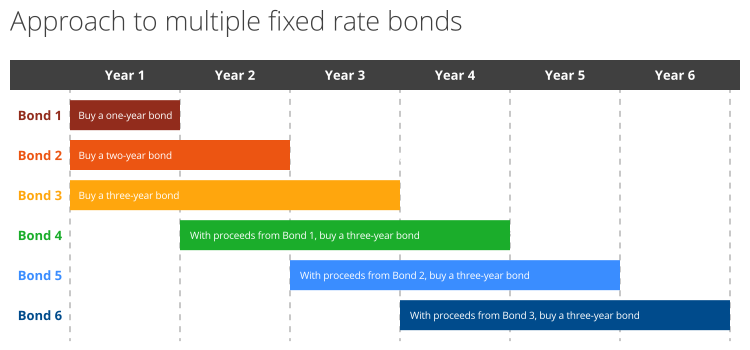
‘Deposit laddering’, otherwise known as the staircase strategy, is a savings approach where deposits are placed across multiple fixed-term bonds with varying terms and interest rates.
When one bond matures, you reinvest the money into a new, longer-term bond, ideally at a higher rate. Over time, you build a “ladder” of bonds, giving you regular access to your funds while still benefiting from returns on longer-term deposits.
This strategy provides some protection from interest rate changes. While some of your money is locked away, meaning you typically cannot withdraw it until the term ends, the rest remains available to deposit if rates increase. While you may not earn as much as locking your entire savings away in a single fixed rate, you may be more insulated from the impact of rate changes.
Raisin UK offers competitive savings products from over 40 partner banks and building societies, including fixed rate bonds, notice accounts and easy access savings accounts. Simply create your free account and fill out a single application to compare accounts and grow your money with our partner banks. Start saving today.
A huge fan of Raisin
Used their service since they started in the UK and couldn't rave more about the variety of savings accounts, the rates and their service.
Trustpilot | 10th July 2025
Lots of choice when it comes to savings…
Lots of choice when it comes to savings in one app whether it's easy access/fixed rate bonds or notice accounts - easy with competitive interest rates.
Trustpilot | 5th July 2025
Easy to save in different types of accounts
I am able to move money from one account to another, and open accounts with a few keystrokes. This is all because Raisin checks my credentials once then allows me to save with them.
Trustpilot | 5th July 2025

All interest rates displayed are Annual Equivalent Rates (AER), unless otherwise explicitly indicated. The AER illustrates what the interest rate would be if interest was paid and compounded once a year. This allows individuals to compare more easily what return they can expect from their savings over time.
Raisin UK is a trading name of Raisin Platforms Limited which is authorised and regulated by the Financial Conduct Authority (FRNs 813894 and 978619). Raisin Platforms Limited is registered in England and Wales, No 11075085. Registered office: Cobden House, 12-16 Mosley Street, Manchester M2 3AQ, United Kingdom. The information on this website does not constitute financial advice, always do your own research to ensure it's right for your specific circumstances. Tax treatment depends on the individual circumstances of each customer and may be subject to change in the future.


