
How to save for a wedding
Everything you need to know about saving for a wedding.
Preparing for the perfect wedding requires detailed planning, from picking your ideal venue to budgeting and managing your finances. Understanding typical costs and how to save for a wedding in the UK can help shape your plans and bring your special day to life.
In this guide, you’ll find an overview of wedding budgeting, practical tips to help you save, ideas for reducing costs, and a summary of savings accounts you can use to help earn interest on your funds.
Key takeaways
The average cost of a wedding is close to £22,000, but factors such as location, guest numbers, and the type of celebration will influence the overall price tag.
Many couples spend more than they originally planned on their wedding. Setting a realistic budget based on detailed estimates can help you stay on track.
If you open a dedicated savings account, you can earn interest on your money while keeping your wedding fund separate from your everyday spending.
The information provided here is for informational and educational purposes only and does not constitute financial advice. Please consult with a licensed financial adviser or professional before making any financial decisions. Your financial situation is unique, and the information provided may not be suitable for your specific circumstances. We are not liable for any financial decisions or actions you take based on this information.
How much do I need to save for a wedding based on average costs?
The amount you need to save for your wedding depends on the type of celebration you want. An average UK wedding costs around £21,990*, including the costs for a wedding cake, wedding, rehearsal dinners, reception, décor, professional photography, etc. However, this can vary significantly depending on the choices you make.
When deciding how much to save for a wedding, you’ll need to consider the type of wedding you want, how many guests you’ll invite and your priorities for your special day. Location plays a major role in your overall expenses, and getting married in a city centre or a historic venue will likely cost more than a local parish hall or a rural setting.
Getting married abroad is another popular option. While a destination wedding can sometimes reduce the cost per guest, you will need to factor in travel, accommodation, and exchange rates. Research locations early to get a realistic idea of the required budget, and to see if packages might be available.
How do couples fund their weddings?
According to wedding industry data, most couples rely primarily on their personal savings to fund their big day. By putting aside a set amount of money each month, you can gradually build up your wedding fund. Opening a dedicated savings account can help you track your progress. Some couples also choose to extend their engagement period to spread the costs over several years and give themselves more time to save.
Family contributions are another common way to cover expenses, with over 60% of couples using financial gifts or parental support to help fund their weddings.* Some couples also use credit cards or take out loans. However, using savings where possible can help you build your wedding fund without taking on additional debt.


How to save for a wedding
Taking a structured approach to saving can help you manage wedding costs with more confidence. Here are three steps that may help organise your finances ahead of the big day.
1. Set a realistic wedding budget
Setting a clear wedding budget helps you understand how much you’ll need to save and determine what is and isn’t possible.
Start by making a list of everything you want and putting a cost against it. It’s a good idea to have clear estimates for everything, and to compare costs across different providers.
To work out what’s realistic, you’ll need to make a savings plan. Start by deducting regular expenses from your monthly income to work out what you can afford to save. If your target is too ambitious, you may need to adjust your savings goals or extend your timeframe (if possible). Work out how much you can realistically save in the time you have left, and remember to factor in any existing savings or contributions towards the wedding.
Research suggests many couples spend more than they anticipate, so building in a margin can make your budget more resilient. Setting up a simple budget planner can help you track expenses and adjust your plans if required.
2. Start saving for your wedding as soon as you can
There’s no one-size-fits-all answer to the question “how long does it take to save for a wedding?,” but starting early allows for more flexibility and helps to manage the costs. Many people open a dedicated savings account to keep their wedding fund separate and earn interest on their balance.
You can compare different types of accounts to see which features align with your timeline and priorities.
- Easy access savings accounts allow more flexible withdrawals.
- Notice accounts offer access after a set notice period and may provide a more competitive rate.
- Fixed rate bonds can be suitable if you already have a lump sum and don’t need to access the money for a set period. Keep in mind that you can’t typically withdraw your funds before the term ends, meaning this option isn’t suitable for paying early supplier invoices (such as deposits on venues).
ISAs may be an option to consider if you will exceed your personal savings allowance (PSA), giving you a tax-free wrapper for savings of up to £20,000 (as of the 2026/27 tax year).
Always review the terms and conditions before opening a savings account, especially where early withdrawals may result in fees or restrictions.
3. Monitor your wedding savings
Make sure you keep track of your money and stay on top of your budget and costs. Consider creating a detailed wedding budget spreadsheet or using a budgeting app to track expenses. You can then categorise your costs and regularly update expenses to maintain a clear overview.
It’s also important to shop around and compare wedding savings accounts, so you can find a competitive interest rate for the type of savings account that suits you.
How to save for a wedding quickly
If you’re hoping to tie the knot sooner rather than later, a quick review of your monthly spending can reveal extra room to save. Even small adjustments can help you make steady progress towards your budget.
Some couples explore savings products such as variable rate notice accounts or 1 year fixed rate bonds. These earn interest on your balance, but each works differently. Compare features like access rules and interest rates to see which option fits your timeline, as fixed rate bonds usually don’t allow early withdrawals.
You can also speed things up by trimming wedding costs, creating a day that feels special without overspending.
Open a 1 year fixed rate bond
How to plan a wedding on a budget in the UK
Start by agreeing on what truly matters to you both. The key is to prioritise, focusing on your non-negotiables such as the venue, food, or photography.
For the remaining parts of your wedding, map out costs and find more affordable options. One of the most effective ways to lower the overall price tag is to keep your guest list smaller, reducing spend on venue space, catering, invitations and more.
14 tips to help you fund your wedding
These tips can help you plan an affordable celebration and make your money go further.
1. Choose an unconventional day or season for your wedding
You may pay less if you get married out of season or on a weekday. The UK’s peak wedding season’ typically runs from May to October.
2. Consider an alternative approach to your wedding
Taking a different approach to the conventional white wedding at a traditional venue can help you keep costs down. A simple ceremony at a town hall or registry office followed by a celebration at home or in a local restaurant can be warm and memorable.
3. Understand what’s included
Ask your venue for a breakdown of everything included in the cost. Small, unexpected extras can add up. You could also ask if the venue is willing to drop certain extras to help trim costs.
4. Look for cheaper venues
Many different types of venue can suit smaller budgets, especially if you don’t have a large guest list. While they may lack the grandeur of some venues, a cheaper venue can still be characterful and personal, and you will free up some of your budget to spend elsewhere.
5. Ask about cancellations
Weddings are cancelled for all kinds of reasons, which may give you an opportunity to secure your dream venue at a discounted price. Just keep in mind that venues often become available at short notice, which could have a knock-on effect for your guest list and wedding preparations.
6. Make use of family heirlooms
Rather than splashing the cash on new rings, you can save money and make it extra special by using jewellery belonging to family members or loved ones. While you might have to get the rings resized, the cost is often much lower than buying new ones. You might take the same approach to wedding dresses, getting a vintage one altered instead of buying new.
7. DIY invitations, RSVPs, table plans and cards
Making your own wedding invitations, RSVPs, table plans, and table cards can save you a substantial amount of money. Consider handing out your invitations instead of posting them, or look into the growing trend of email wedding invitations.
8. Make use of talented friends
Other expensive parts of a wedding include photography, hair and makeup, and the DJ. If you’re saving for a wedding on a budget and happen to have friends with talents in any of these areas, consider asking them to contribute as a wedding gift, or for a small charge to save you some cash.
9. Skip the formalities
Weddings are steeped in tradition, but it’s up to you which elements you want to include. Swapping the canapés, three-course meals, and champagne toasts for more budget-friendly, relaxed options can reduce your costs.
10. Shop second-hand or hire your outfits
You’re unlikely to wear your wedding attire again. Shopping second-hand can help save you money and reduce your carbon footprint too.
11. Drop the ‘W’ word
There’s often a hidden surcharge when shopping for a wedding. When shopping for your dress, decorations, and other items, don’t mention they’re for a wedding and you could make some savings.
12. Include a contingency in your budget
When setting your wedding budget, it’s a good idea to include a 5-10% contingency to cover unexpected costs. If you don’t need this money, you could use it for a honeymoon or transfer it into an emergency fund as you plan for the future.
13. Open a wedding savings account
Consider opening a savings account dedicated to your wedding. This not only helps you stay on track but also lets you earn interest, which could help your money grow over time. Compare accounts and see what you could earn on your savings.
14. Compare, compare, compare
Compare costs for everything you’ll need, from venues and cakes to photographers and honeymoon packages. It takes time, but will help you find the best budget-saving options.
A typical wedding budget breakdown
While every celebration is unique, understanding how a typical wedding budget is divided can help you allocate your own funds. According to industry estimates,* venues and catering typically account for 51% of a wedding budget on average. Attire takes up 19%, photography is 10%, and entertainment comes in at 7%.
This breakdown only covers the wedding day itself. It does not include the cost of an engagement ring or a honeymoon, which are typically budgeted for separately and can add an average of £5,211 to your overall expenses.
What savings accounts can be used to save towards a wedding?
You can grow your savings by earning interest in a dedicated account. Depending on your timeframe and financial goals, different types of savings accounts might suit your needs.
If your wedding is a year or more away, you might want to look into fixed rate bonds, which typically offer higher interest rates. For larger savings pots where your PSA could be exceeded, an ISA can ensure you don’t pay tax. If you need more flexibility, notice accounts or easy access accounts might be a better fit.
View wedding savings accounts
Account type | How it works | Good for... |
Fixed rate bonds | Deposit a lump sum for a set period with a fixed rate. | Existing lump sums when no early access is needed. |
Notice accounts | Rates are variable and advanced notice is required for withdrawals. As rates are variable, the interest you earn can go up or down. | Paying planned vendor invoices and costs with fixed dates along the way. |
Easy access accounts | Flexible deposits and withdrawals, with typically lower rates. | Regular deposits and unexpected expenses. |
ISA | Deposit up to £20,000 per tax year and earn tax-free interest. | Saving larger amounts where interest might exceed PSAs. |
Frequently asked questions
How can I create a simple monthly savings plan for a wedding?
First, set a realistic target budget. Second, review your monthly income and regular outgoings to calculate how much you can realistically set aside. Finally, automate your savings by scheduling a direct debit to transfer money into a dedicated wedding fund right after payday. Learn more about Raisin’s Savings Plan feature.
How do interest rates affect my wedding savings?
Higher interest rates can help your money grow without having to save extra cash. By placing your wedding fund in a competitive savings account, the interest you earn can help offset rising costs or provide extra budget for your honeymoon.
Are there UK government schemes or tax advantages to help save for a wedding?
While there are no specific schemes just for weddings, you can take advantage of the Personal Savings Allowance (PSA). The PSA allows basic rate taxpayers to earn up to £1,000 in savings interest tax-free each year (or £500 for higher rate taxpayers), which may help maximise your wedding fund.
How to open a savings account at Raisin UK
You can open a savings account for your wedding through Raisin UK in just a few steps. After registering for a Raisin UK Account, simply log in to explore savings products from a range of UK banks and building societies.
Opening an account is free. Once you’ve been approved, you can transfer your deposit and manage your savings from your online account. This gives you one place to view your balances, compare options, and stay on top of your progress as you plan for your day.
Register now
The fictional wedding calculator
We evaluate famous weddings from film and TV, from the big spenders to the budget brides. Who splashed out and who kept to a budget, and what are the estimated costs?
They’re the moments that made us smile, sigh, or even brought tears to our eyes. Weddings on TV and film show the happiest moments for some of our favourite characters, and are often what the whole plot has been leading up to. They can take hours, months, or even years to happen, and if we’ve been following the romance from the start, it almost feels as if we’re one of the guests.
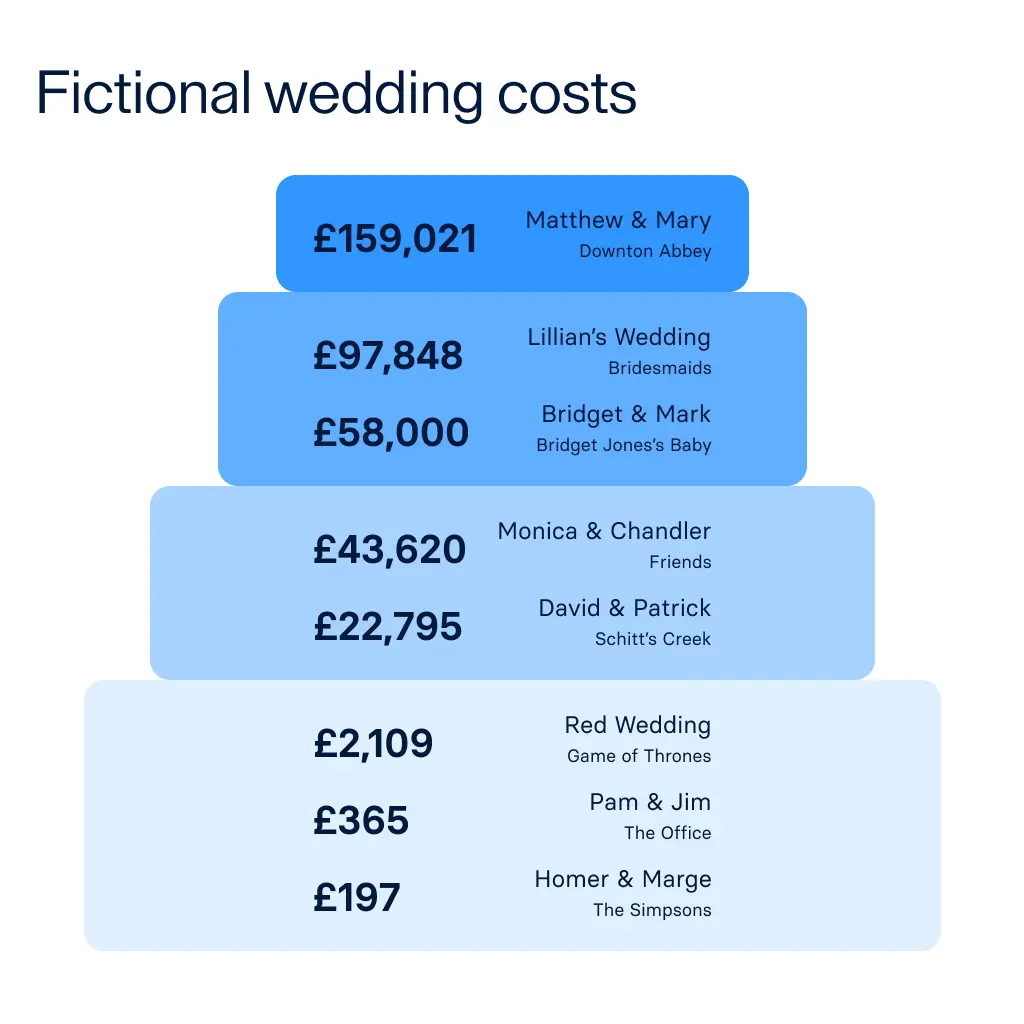
How much did famous fictional weddings cost?
So, just how much do these fantasy weddings cost, and could the bride and groom really afford them on their wages? We put all the soppy, romantic stuff to one side and get to the heart of the issue.
The big spenders
Some of the most lavish on-screen weddings have seen hundreds of thousands splashed out on extravagant venues, food and entertainment. However, the most expensive is widely thought to have been Colin and Araminta’s wedding from Crazy Rich Asians. As the title suggests, they certainly were crazy rich, with a huge family fortune helping them spend £6.45 million on their romantic bash.
Given that Araminta is heir to a hotel chain’s wealth, this amount of money would have been small change for such an occasion. We don’t imagine they needed to save at all.
Other high spenders were Matthew and Mary from Downton Abbey, whose wedding set them back £159,021. Not a small sum of money by any means, but when your dad is the Earl of Grantham (worth an estimated £800 million in today’s money) we reckon this wedding didn’t break the bank.
Carrie and Big come in third place, with the Sex and the City pair splashing out £114,484 for their long-awaited celebration. As Big was a financier and a fairly prolific investor, he was rumoured to earn millions. Meanwhile, Carrie was a freelance writer charging Vogue 50 cents per word, so she was doing alright too.
The fourth most expensive wedding is that of Lillian in Bridesmaids, costing around £97,848. With her dad primarily funding the ceremony, having a generous parent certainly comes in handy on such occasions.
Wrapping up our top five is Annie and Bryan’s wedding from Father of the Bride. In the film, Bryan’s parents live in a Bel-Air mansion, so it’s not hard to guess where they might have found the £67,822 needed for their ceremony.
The around averages
The average UK wedding (excluding rings and honeymoon) costs £19,184*, putting the wedding costs of the next five fictional couples comfortably in the middle range. This makes them much more reasonable to save for, especially for those with well-paying jobs.
At the top of the list is the long-awaited wedding of Bridget Jones and Mark Darcy in Bridget Jones’ Baby. At £58,000, this wedding price tag might have been a little out of reach on Bridget’s publishing salary, but as Mark is a successful barrister, he could easily afford it.
Next up is one of the most famous weddings of all time. When Cinderella married her Prince Charming, it became a dream for many young girls across the world. The prince’s wealth undoubtedly helped, as their big day cost £57,398 to put together, with a little help from the Fairy Godmother coming as a wedding gift.
Could it be any more romantic? When Chandler finally tied the knot with Monica, Friends fans worldwide let out a small cry. With a wedding cost of £43,620, we’d imagine the married couple did too. However, given how much money they were saving on their rent-controlled flat, it could well have been within their means.
Bella and Edward’s wedding in Twilight came in at just over the UK average, costing the vampire and his wife around £26,516. Saving up for a wedding is definitely easier if you get to live forever, and as Edward’s adopted father was a doctor, his salary no doubt helped too.
At £22,795, the wedding of Schitt’s Creek’s David and Patrick might have seemed extravagant after the Rose family lost their fortune. However, with the couple running a store, the father’s motel business thriving, and their friends contributing to the event, the couple were thrifty when it came to their planning.
*https://bridebook.com/uk/article/how-much-does-a-wedding-cost-the-2023-uk-average
The budget brides
You don’t have to spend big on a special occasion. In fact, some of the big screen’s most famous marriages have come in way under budget and still packed an emotional punch.
In How I Met Your Mother, Lily and Marshall put on their outdoor wedding for only £13,890, using nature to set the scene for their long-awaited party.
Another of TV’s famous couples, Mitch and Cam from Modern Family, spent even less. Their wedding cost only £11,000, which, given Mitch’s work as a lawyer, should have been easy enough to save up for.
Shrek and Princess Fiona slashed costs on their big day in a land far, far away, spending a modest £9,920 to tie the knot. Admittedly, Fiona’s royal background may well have helped her save up the funds, although we’re not sure how they managed to afford Donkey’s wild after-party.
At the lower end of our wedding cost scale, Mamma Mia’s Sophie and Sky only spent £9,373 on their big day, which is fair enough, given how Sophie’s mum stole the spotlight, and we never actually see the two walk down the aisle. We’ll leave what happened next up to your imagination.
The title for the cheapest wedding in film or TV, however, goes to Homer and Marge for their Vegas nuptials in The Simpsons. While Homer and Marge’s romance has lasted more than thirty years for viewers, the on-screen timeline remains a topic of debate. Featured in the third-season episode ‘I Married Marge’, by getting married in a Vegas chapel, they cut huge venue costs, spending only £197 on the whole occasion. It’s safe to assume Marge and Homer would’ve had ample time to save for the meagre cost of their wedding.
Planning a wedding of your own?
Along with buying a house, your wedding day could easily become the most expensive thing you ever splash out on. How big you go is up to you, but whatever you decide to do, our marketplace is home to savings accounts to help you grow your money and make every pound towards your wedding count.
It only takes a few minutes to register for a Raisin UK Account. Once registered, you can click to apply for savings accounts from a range of specialist banks and building societies.
Register now
Methodology:
Each wedding cost calculation includes a combination of canon information, cost of real-life venue hire or approximates based upon fictional location and average costs for things like dresses, flowers, transportation and entertainment, and consolidated by Katie, a wedding planner from Albion Parties.



Als Pionier für Spar-, Investment- und Altersvorsorgeprodukte ermöglichen wir Privatkunden einen unkomplizierten Zugang zu globalen Einlagen- und Kapitalmärkten – ein Vorteil, der auch Finanzinstitute stärkt.
About us
Savings accounts
Guides
About us
Savings accounts
Guides
All interest rates displayed are Annual Equivalent Rates (AER), unless otherwise explicitly indicated. The AER illustrates what the interest rate would be if interest was paid and compounded once a year. This allows individuals to compare more easily what return they can expect from their savings over time.
Raisin UK is a trading name of Raisin Platforms Limited which is authorised and regulated by the Financial Conduct Authority (FRNs 813894 and 978619). Raisin Platforms Limited is registered in England and Wales, No 11075085. Registered office: Cobden House, 12-16 Mosley Street, Manchester M2 3AQ, United Kingdom. The information on this website does not constitute financial advice, always do your own research to ensure it's right for your specific circumstances. Tax treatment depends on the individual circumstances of each customer and may be subject to change in the future.