
What are gilts? A simple guide
Learn how you can lend money to the UK government and receive regular interest payments, while understanding the capital risks of purchasing gilts.
Key takeaways
Gilts are bonds issued by the UK government to finance public spending, fund projects and manage debt
: These bonds are considered a lower-risk investment compared to corporate bonds, though your capital is at risk if sold before maturity
: Conventional gilts pay out a regular amount of interest in exchange for lending money, and it’s also possible to make money by selling gilts on the secondary market
The information provided here is for informational and educational purposes only and does not constitute financial advice. Please consult with a licensed financial adviser or professional before making any financial decisions. Your financial situation is unique, and the information provided may not be suitable for your specific circumstances. We are not liable for any financial decisions or actions you take based on this information.
What are gilts?
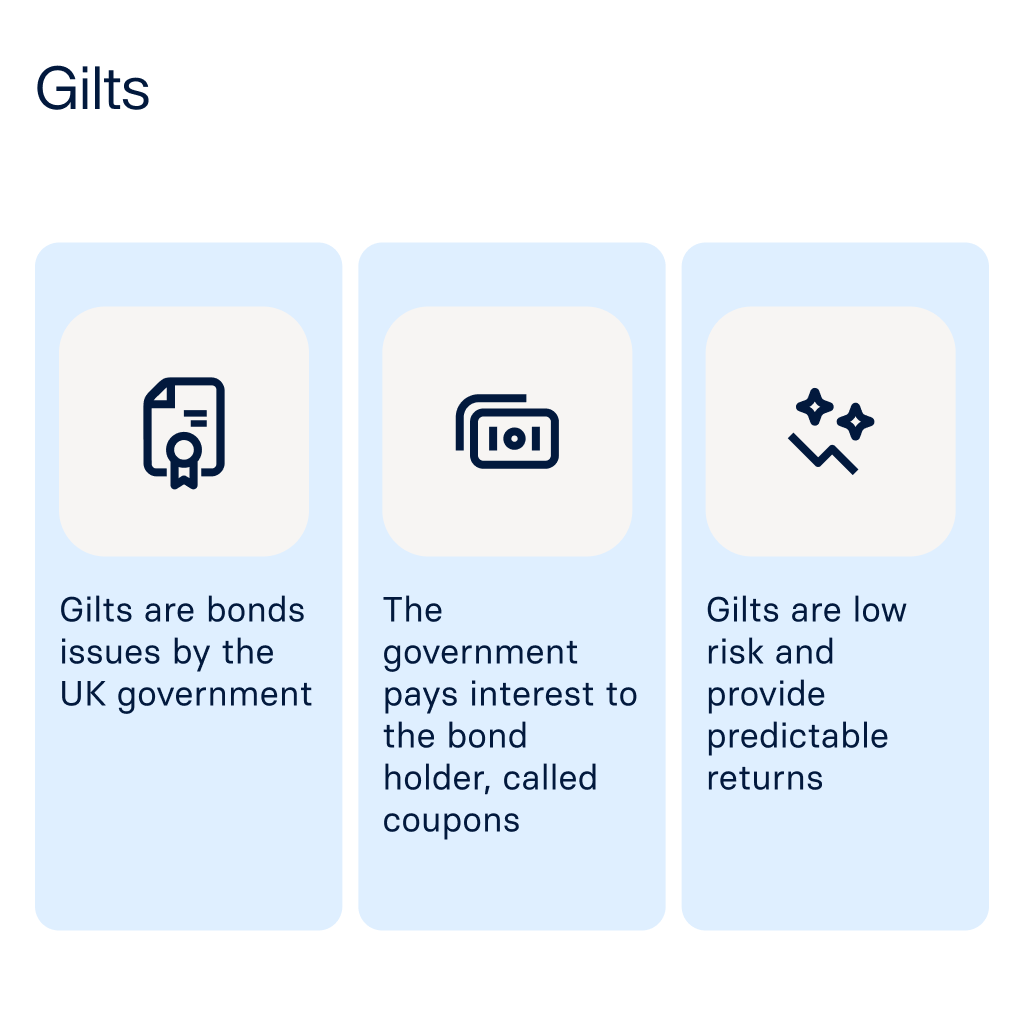
Gilts are bonds issued by the UK government in order to borrow money from investors. In return for the loan, the government pays interest and returns the principal when the bond matures. UK gilts are generally considered to be low risk by financial advisers, pension funds and other experts, as the government has never defaulted on its debt and is deemed unlikely to in future. However, their market value can fluctuate, and past reliability does not guarantee future performance.
Gilts partly get their name from the paper bond certificates that used to be issued, which had a gilded edge. The name can also refer to their reputation as a low-risk investment from a stable issuer.
How do gilts work?
Gilts are a type of bond, or fixed income security. As with a loan from a bank or another provider, interest is paid by the UK government in exchange for purchasing the bond and lending them money. For investors buying conventional gilts, a fixed amount of interest is paid, which is called a coupon. The principal is also returned when the bond matures – this is usually fixed at £100 per unit, so if you buy the gilt on the secondary market for a lower price, there is the potential to make a higher yield. Equally, if the value of the gilt drops after you buy it, you risk selling it at a loss. If this is the case, some investors may choose to hold the bond to maturity instead.
Types of gilt
Investors can choose from conventional gilts or index-linked gilts:
- Conventional gilts make up the majority of the market, paying out a fixed coupon amount throughout the bond’s term and returning the principal when it reaches maturity.
- Index-linked gilts adjust the coupon and principal based on the Retail Price Index (RPI). RPI is a legacy measure and may differ from CPI.
There are also gilt funds, which are mutual funds and exchange traded funds (ETFs) that primarily invest in UK government bonds. These are usually used for conservative investment strategies like capital preservation.
What are the risks and benefits of investing in gilts?
These are some of the main reasons why people might choose to buy gilts:
- Regular returns: Conventional gilts pay a fixed amount of interest at regular intervals.
- Low risk profile: Gilts are typically viewed as a lower-risk debt instrument, but their market value can fluctuate.
- No CGT on sales: While interest is taxable, gilts are exempt from capital gains tax (CGT) when sold or when maturing at a higher value than the purchase price.
- Competitive yields: Gilt yields currently reflect the 2026 interest rate environment and market expectations for inflation.
- Lower volatility: Investors often see gilts as a safe haven when stock market volatility is high.
Risks to consider:
- Lower coupon payments: Gilts are seen as low risk, so coupon payments may be lower than on other types of bond.
- Value erosion from inflation: The principal and coupon payments are not adjusted for inflation which erodes real returns, especially on longer-term gilts.
- Rate sensitivity: When interest rates rise, the market value of existing gilts can fall so you might get back less than you paid if you sell them.
- Opportunity cost: The stock market and other types of bonds may offer higher returns, especially in a low interest rate environment where gilts offer limited interest.
- Lack of FSCS deposit protection: Unlike cash savings accounts, gilts are investments and are not protected by the Financial Services Compensation Scheme (FSCS) against market losses.
How to buy and sell gilts
You can buy gilts directly from the Government's Debt Management Office, but would need to join an Approved Group of Investors. Instead, you can use a stockbroker or investment platform to buy and sell gilts. This way, you can buy and sell gilts before they reach maturity. You may also be able to hold gilts in a Stocks and Shares ISA (subject to the £ 20,000 annual allowance for 2026/27) to shield returns from tax.
Gilt yields explained
Yields show how much income you can make on a gilt when you hold it to maturity. They are expressed as a percentage of the market value. While the income you receive (the coupon) doesn’t change throughout a conventional gilt’s term, yields fluctuate with market value. For example, when a bond’s price is below face value, the yield will be higher than the same bond priced above face value. Yields also change as coupons change, which are primarily linked to interest rates and the gilt’s term.
How does interest on gilts get taxed?
The coupon payment on gilts is counted as savings income, so you will be taxed on this based on your tax band. It counts towards your personal savings allowance of £1,000 for basic rate taxpayers and £500 for higher rate taxpayers. You’ll need to report savings income to His Majesty’s Revenue and Customs (HMRC) via self-assessment if it is higher than your personal savings allowance.
Any profit made from selling bonds is free from CGT, regardless of the amount, so if you sell a gilt for more than you bought it, you will not be taxed on the gain and will not need to report it to HMRC.
How can gilts support long-term saving goals?
Gilts can offer predictable, low-risk returns as part of a wider savings and investment strategy.
If you’re looking for other ways to save securely, explore our online savings accounts. Deposits are protected up to £120,000 per bank and per depositor under the statutory Financial Services Compensation Scheme (FSCS). We offer a wide range of easy access savings accounts, notice accounts, and fixed rate bonds. You can easily find an account to suit your needs from a variety of banks and building societies. Simply register for a free Raisin UK Account, choose a savings account, deposit your money and watch your savings grow.
Frequently asked questions about gilts
What’s the difference between gilts and bonds?
Gilts are a type of bond, which are debt securities issued by governments and corporations. Gilts is the name given to bonds issued by the UK government to fund public spending. Buying a gilt is essentially lending money to the UK government.
What’s the difference between gilts and premium bonds?
Gilts are a type of debt security, or bond, issued by the UK government, offering fixed interest payments and returning the principal when the gilt matures. Premium bonds are non-tradeable savings products issued by National Savings and Investments (NS&I), which offer the chance to win monthly cash prizes.
While both are known as bonds, they are different offerings and investors should understand that they operate in different ways.
Can an individual buy UK gilts?
Yes, individual investors can buy UK gilts, usually via a stockbroker or investment platform. It’s possible to buy gilts directly from the Government's Debt Management Office, but you would need to be on a list of approved investors so most people use a stockbroker or platform instead.
Can gilts help you pay less tax?
Yes, gilts can help you pay less tax because profits made from selling them are not subject to CGT. However, the interest paid to you from a gilt is taxable and individuals are responsible for reporting this savings income to HMRC and paying tax on it if the interest earned via the gilt and other savings products exceeds your personal savings allowance for the tax year.

About us
Savings accounts
Guides
About us
Savings accounts
Guides
All interest rates displayed are Annual Equivalent Rates (AER), unless otherwise explicitly indicated. The AER illustrates what the interest rate would be if interest was paid and compounded once a year. This allows individuals to compare more easily what return they can expect from their savings over time.
Raisin UK is a trading name of Raisin Platforms Limited which is authorised and regulated by the Financial Conduct Authority (FRNs 813894 and 978619). Raisin Platforms Limited is registered in England and Wales, No 11075085. Registered office: Cobden House, 12-16 Mosley Street, Manchester M2 3AQ, United Kingdom. The information on this website does not constitute financial advice, always do your own research to ensure it's right for your specific circumstances. Tax treatment depends on the individual circumstances of each customer and may be subject to change in the future.