
Minimum wage Ireland changes in 2025 & 2026
Learn more about recent changes to the Ireland minimum wage in 2026 following the latest Irish budget announcement.

As of 1 January 2026, the national minimum wage in Ireland is €14.15 per hour for workers aged 20 and over. Almost every worker in Ireland is entitled to the National Minimum Wage (NMW), and some employers also offer the higher rate living wage. In this article, you’ll learn what the minimum wage is, how it’s decided and how minimum wage affects workers depending on their age.
Key takeaways
As of 1 January 2026, the national minimum wage in Ireland is for workers aged 20 and over
The rate you receive is For instance, the current Irish minimum wage, if you’re under 18, is
You if you're on minimum wage
The information provided here is for informational and educational purposes only and does not constitute financial advice. Please consult with a licensed financial adviser or professional before making any financial decisions. Your financial situation is unique, and the information provided may not be suitable for your specific circumstances. We are not liable for any financial decisions or actions you take based on this information.
What is the minimum wage in Ireland?
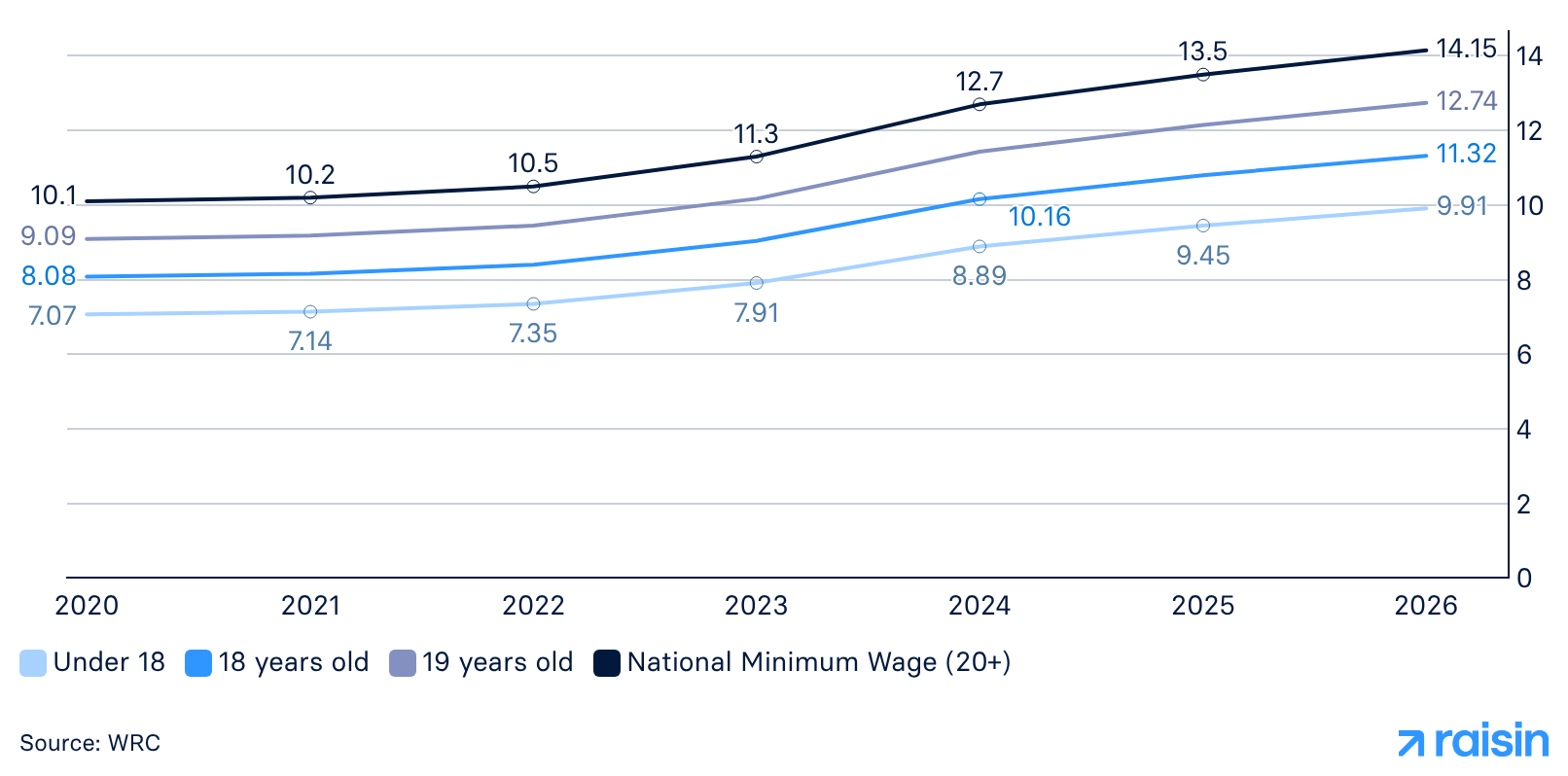
The NMW is the minimum wage per hour a worker is entitled to earn in Ireland by law. The minimum wage you receive depends on your age and your professional sector. For instance, the national minimum wage if you're 20 and over is €14.15 per hour, while the minimum wage for 19-year-olds is €12.74 per hour.
20 and over | €14.15 | 100% |
19 | €12.74 | 90% |
18 | €11.32 | 80% |
Under 18 | €9.91 | 70% |
How is the minimum wage decided?
The hourly rate a worker receives is determined by both their age and whether or not that worker is an apprentice. You’re only entitled to the NMW if you’re of school leaving age, which is 16. The government of Ireland sets the minimum wage rates, applying them to all employees. This includes those who work full-time, part-time, in a small start-up business and those completing essential training for their job.
Historical minimum wage Ireland 2020-2026 (€)
Are you taxed if you earn minimum wage?
Yes, you might still be taxed on your income even if you earn minimum wage, with different thresholds applicable based on how much you earn and whether you are single, married or in a civil partnership, or are widowed or a surviving civil partner.
It’s worth noting that some parts of your pay don’t count towards your minimum wage. This includes tips, overtime payments, a loan from your employer and a pay advance. Commission, on the other hand, is included. An employer can take certain deductions from your pay, but only for things such as tax, pension payments, trade union fees and any charges for accommodation they provide. An employer cannot use the cost of tools, uniforms, travel or training courses to reduce your pay.
How does Ireland’s minimum wage vary depending on age?
A varying scale of minimum wage exists so that more people of various ages and experience levels can find employment. This was put in place by the government in light of evidence that younger workers were being priced out of jobs.
While younger workers usually receive lower wages than older workers, a couple of reasons for that might be because they often lack the experience and have a higher training cost than older and more experienced employees. Overall, the aim of minimum wage is to ensure a higher percentage of employment for younger people.
What is basic pay?
You may have seen the term 'basic pay' on your payslip. This is your basic salary, not including extra payments such as overtime.
What is the Living Wage?
The Living Wage is a guide, rather than a law, that employers can follow. The aim is to give all employees an income that reflects minimum living costs, which some people argue that minimum wage doesn’t do. The Living Wage is increased each year to reflect changes in the cost of living.
Start your savings journey with Raisin
If you find you’re able to save part of your wages, you could consider opening a savings account that would allow you to plan for your future. To quickly and easily open savings accounts online, consider using our marketplace with 30+ partner banks. Register for a Raisin Account, deposit your savings for free, and watch them grow.

Company & team
Savings accounts
Information
Company & team
Savings accounts
Information
© 2026 Raisin Bank AG, Frankfurt a.M.

All interest rates displayed are Annual Equivalent Rates (AER), unless otherwise explicitly indicated. The AER illustrates what the interest rate would be if interest was paid and compounded once a year. This allows individuals to compare more easily what return they can expect from their savings over time. Raisin Bank, trading as Raisin, is authorised/licensed or registered by BaFin (Bundesanstalt für Finanzdienstleistungsaufsicht) in Germany and is regulated by the Central Bank of Ireland for conduct of business rules.